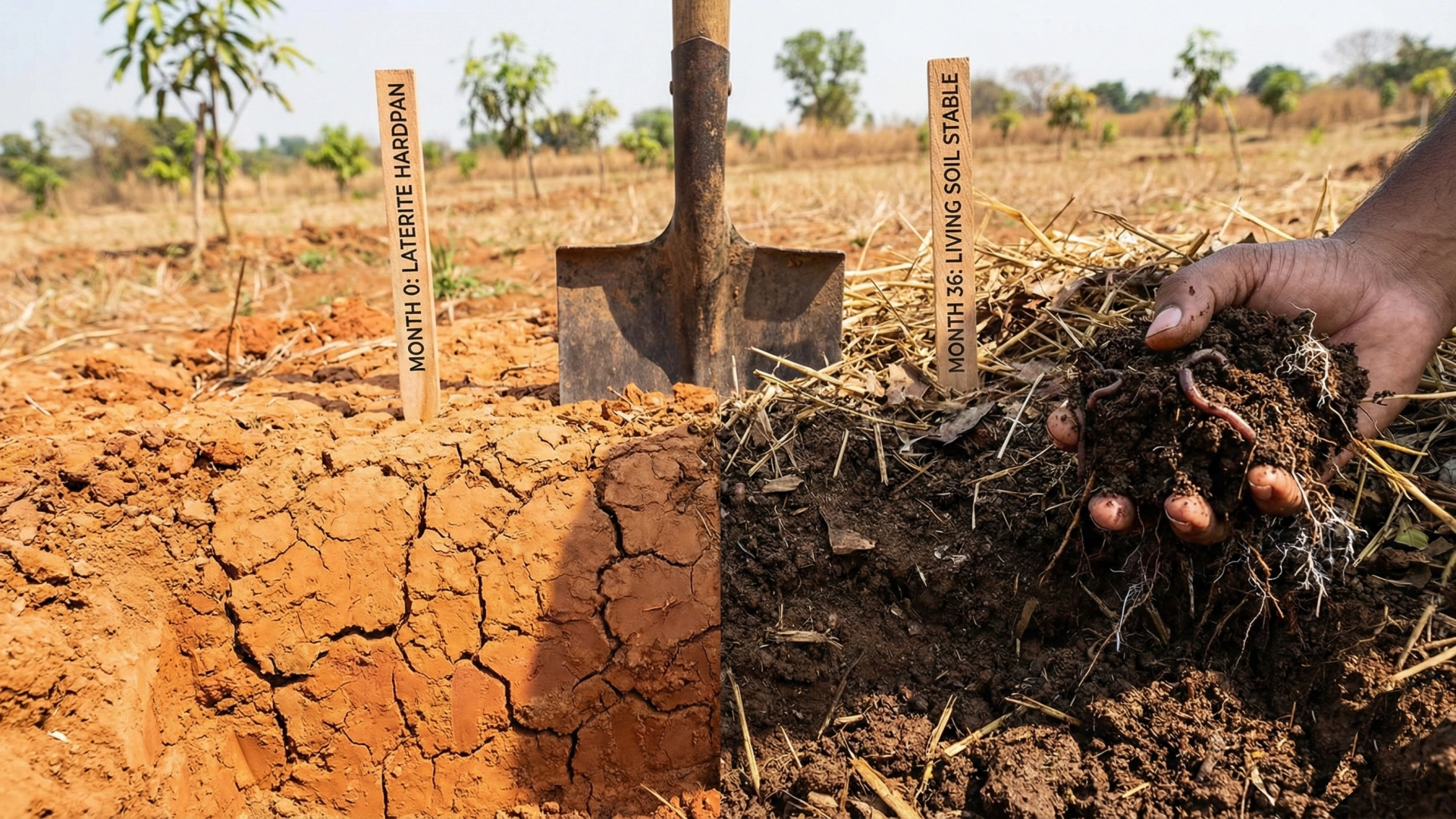
In the red lateritic belt of Birbhum, West Bengal, building living soil is a minimum 36-month biological process. There are no shortcuts. While surface appearance can improve within six months, stabilising Soil Organic Carbon above 0.8 percent and establishing a self-sustaining fungal network requires three full monsoon cycles. Year one repairs physical structure. Year two allows microbial colonisation. Year three enables nutrient cycling. Any claim of “instant soil regeneration” ignores carbon oxidation rates at 45°C and above. In Birbhum’s climate, speed is a marketing metric, not an agronomic one.
Why Soil Regeneration Is Slower in Birbhum
Most regenerative farming advice is written for temperate climates. Birbhum is not temperate.
The lateritic Rarh region functions like a furnace for organic matter. During May, exposed soil temperatures routinely exceed 55°C. At this temperature, organic matter does not merely decompose. It oxidises rapidly. Carbon burns off faster than biology can rebuild it.
The primary challenge here is not adding fertility.
The challenge is retaining carbon long enough for biology to organise itself.
At Terragaon Farms, we learned early that pest pressure is secondary. Heat is the real enemy. Without structural protection from sun and rapid moisture loss, microbes do not survive long enough to matter.
The Origin of the 36-Month Rule
The 36-month timeline is not theory. It is documented reality.
We derived this rule while converting fifteen acres of degraded paddy land into a multi-layer food forest system in Birbhum. We recorded infiltration rates, crop response, colour change, biological indicators, and failure events across seasons.
Every shortcut collapsed.
Every system that worked respected time.
Phase One: Physical Intervention (Months 0–12)
The first year is about water, not fertility.
Lateritic soil behaves like fired brick. Rainwater runs off instead of entering the profile. Without infiltration, biology cannot survive.
The first objective is breaking the hardpan and creating pathways for moisture.
We used deep mechanical ripping to fracture the laterite layer at approximately one and a half feet. This was followed immediately by heavy biomass loading. Light mulching failed consistently.
Dry paddy straw and water hyacinth were applied at roughly eight tonnes per acre. Dhaincha was sown before monsoon and chopped in situ before flowering to add soft green biomass.
This phase carries the highest risk. Errors here are expensive.
Failure Log May 2023
To reduce labour cost, we attempted a thin mulch layer of about two inches. By mid-May, solar radiation penetrated the mulch, overheating the surface layer and killing feeder roots of young saplings.
The lesson was absolute.
In Birbhum, mulch below six inches is cosmetic.
Physical Data Point
At baseline, one litre of water took approximately ten minutes to disappear from the surface. After twelve months, infiltration improved to four minutes. This change alone enabled biology to persist beyond a few days.
Phase Two: Nitrogen Crisis and Microbial Awakening (Months 12–24)
Once moisture retention stabilises, biology enters the system. This phase is unstable and commonly misunderstood.
Microbes do not eat carbon alone. They require nitrogen to digest carbon. If nitrogen is unavailable, microbes extract it from plants.
This is where many natural farms collapse.
We introduced fermented microbial cultures such as Jeevamrut, but timing and balance proved critical. Excess carbon without nitrogen created widespread yellowing across vegetable beds in late 2023.
This was not disease.
It was nitrogen immobilisation.
The Correction
We instituted a strict biomass rule. For every fifty kilograms of dry carbon material, we supplied one kilogram of nitrogen source through fresh dung slurry or mustard oil cake.
Only after this correction did plant colour stabilise and microbial activity increase.
Ground Cost Reality (Per Acre, Annualised)
Cow dung applied through local sourcing required three tractor loads annually, costing approximately six thousand rupees. Biomass transport for five tonnes averaged four thousand rupees. Mustard oil cake at two hundred kilograms cost six thousand rupees. Labour averaged forty-five man-days per year, costing around thirteen thousand five hundred rupees.
Total soil operational expenditure averaged twenty-nine thousand five hundred rupees per acre annually. These figures reflect Birbhum conditions for 2025–26. High-capital experimental approaches such as biochar reactors were excluded due to poor smallholder relevance.
Phase Three: Stabilisation and Nutrient Cycling (Months 24–36)
This phase marks the real transition.
The soil colour shifts visibly from rusty red to chocolate brown. More importantly, soil begins to behave differently.
Native earthworms return. We stopped purchasing vermicompost after observing natural cast production beginning around month twenty-six, following the second monsoon.
Water behaviour changes. During the March 2025 dry spell, un-irrigated plots retained moisture for four days longer than neighbouring chemically farmed land.
Soil aggregates begin to form and remain intact in water. This indicates glomalin production by mycorrhizal fungi, the biological glue that creates stable structure.
At this point, the soil starts cycling nutrients independently.
The Economic Trade-Off Most Advisors Hide
Soil regeneration is not free, and it is not immediately profitable.
In the first year, expect yield reductions of up to forty percent compared to chemical farming. The second year usually reaches parity. The third year delivers surplus through reduced input costs and stabilised productivity.
Any farmer unable to survive two seasons of reduced cash flow should not convert the entire holding at once. Transition must occur plot by plot.
Biology does not negotiate with bank EMI schedules.
Why “Instant Soil” Products Fail Here
Microbial bottles sell workers without providing housing or food.
You can introduce microbes, but without structure and retained carbon, they die within days. In Birbhum heat, this failure is accelerated.
Soil structure cannot be purchased.
Organic carbon cannot be rushed.
Biology requires time protected from entropy.
Final Position of Terragaon Farms
Soil is not built.
It is grown.
In West Bengal’s lateritic belt, regeneration is a three-year biological negotiation with heat, oxidation, and moisture loss. Any system promising fertile soil in ninety days is selling hope, not agronomy.
You can buy microbes.
You cannot buy time.
The 36-month rule is not pessimism.
It is respect for reality.
Next Step: The Field Action
Go to your field. Dig a 6-inch square hole. Pour 1 liter of water into it. If it takes longer than 15 minutes to drain, your soil is sealed.
Frequently Asked Questions (FAQs)
How long does it take to build soil in lateritic regions
In Birbhum-type lateritic soils, true biological soil formation requires at least thirty-six months.
Why does soil regeneration take longer in West Bengal
Extreme heat accelerates carbon oxidation and kills surface biology, slowing regeneration.
Can microbes regenerate soil quickly
Microbes alone cannot regenerate soil without structure, moisture retention, and carbon.
What is the biggest mistake in soil regeneration
Using thin mulch and ignoring nitrogen balance during early stages.
Is it profitable to regenerate soil
Yes, but only after two to three years when input costs fall and resilience improves.

Krittika Das is a field practitioner and primary author at Terragaon Farms in Birbhum, West Bengal. Her writing is grounded in daily farm work, long-term soil observation, and small-land realities of eastern India. She focuses on natural farming, soil ecology, ethical dairy, and low-input systems, translating field experience into clear, practical knowledge for farmers and conscious food consumers.