
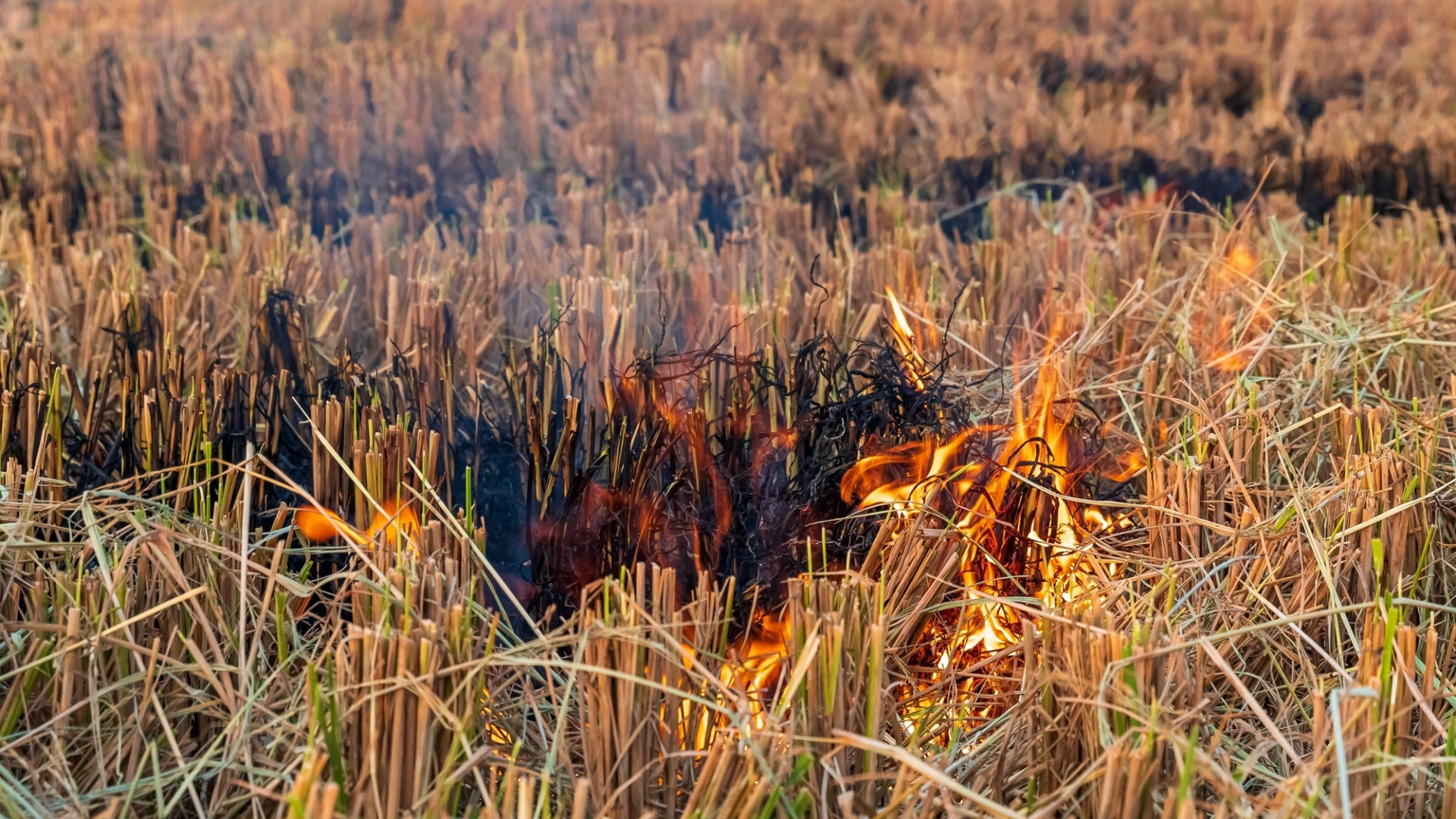
Crop residue can be managed without burning by retaining residues on the soil surface as mulch, selectively incorporating them into the topsoil, or reallocating them to livestock and compost systems. At Terragaon Farms in Birbhum, West Bengal, field observations show that residue retention improves soil moisture stability, reduces surface crusting, and increases soil organic carbon, while burning causes permanent biological loss and long-term yield instability.
Why Crop Residue Burning Persists in India
Residue burning continues not because farmers are unaware of harm, but because alternatives often ignore ground constraints.
Small farmers burn residue due to labour shortages, narrow sowing windows, fear of pest carryover, and lack of mechanised residue handling. Any non-burning method must work under low capital, high heat, and unpredictable rainfall conditions.
Residue management fails when it is taught as an environmental obligation rather than a soil survival strategy.
What Crop Residue Actually Does in Soil
Crop residue is not waste. It performs three physical functions before it performs any nutritional role.
Residue buffers soil temperature by reducing direct solar exposure.
Residue slows rainfall impact, reducing surface sealing.
Residue feeds soil biology gradually rather than in a single nutrient pulse.
When residue is burned, these functions are permanently lost in one event.
Field Observation From Birbhum Without Burning
Location: Birbhum district, West Bengal
Cropping system: Paddy, mustard, mixed vegetables
Observation period: February 2024 to October 2025
Residue retained on soil showed slower moisture loss in summer, reduced cracking, and better root penetration during early monsoon. Burned plots showed rapid surface hardening, poor infiltration after first rains, and weak seedling anchorage.
Chart Observation From Terragaon Farms
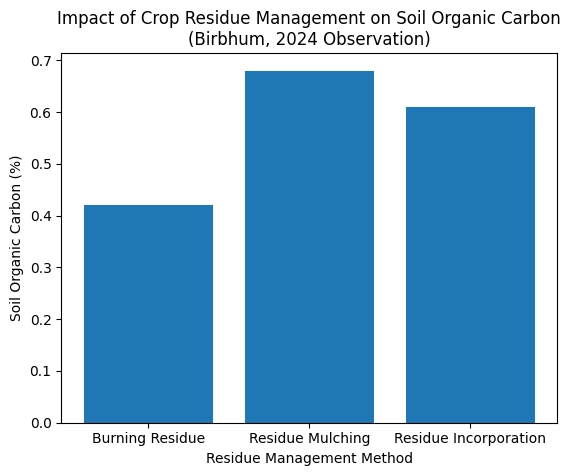
The chart above shows the impact of different residue management methods on soil organic carbon, measured across comparable plots during the 2024-25 agricultural cycle in Birbhum.
Burning residue resulted in the lowest soil organic carbon.
Residue mulching showed the highest carbon retention.
Residue incorporation improved carbon but created temporary oxygen stress in heavy rain.
This confirms that how residue is handled matters more than how much residue exists.
Methods of Crop Residue Management Without Burning
Surface Mulching With Residue
Residues are cut and spread evenly on the soil surface.
This method works best for vegetable beds, rainfed plots, and orchards. It reduces evaporation, suppresses weeds, and protects soil aggregates. Pest pressure remained manageable when residues were thinly spread and not piled.
Partial Residue Incorporation
Residue is mixed only into the top 5 to 7 centimetres of soil.
This method suits light-textured soils but must be avoided before heavy monsoon rain. Deep incorporation caused oxygen stress and delayed germination in our trials.
Residue Reallocation to Livestock and Compost
Surplus residue can be redirected to cattle bedding, fodder mixing, or compost input.
At Terragaon Farms, this closed nutrient loops without exposing soil directly to burning or complete removal.
Why Burning Is the Worst Option Agronomically
Burning removes carbon instantly, sterilises surface biology, and increases soil temperature volatility. Short-term ease is exchanged for long-term instability.
In Birbhum conditions, burned plots consistently required more irrigation, showed higher weed flush after first rain, and responded poorly to compost application.
Burning creates a soil that becomes input-dependent.
Common Concerns About Not Burning Residue
Farmers fear pest buildup, delayed sowing, and nutrient lock-up.
Field observation showed that thin mulching and timely residue cutting prevented pest sheltering. Nitrogen lock-up was temporary and disappeared within one crop cycle when residue was managed correctly.
The real risk is not residue retention. The real risk is unmanaged residue.
Final Position of Terragaon Farms
Crop residue should never be burned.
It should be managed as a soil-regulating asset.
Non-burning residue management stabilises soil temperature, preserves moisture, and builds resilience under heat and erratic rainfall. Burning solves a short-term labour problem by creating a long-term soil problem.
Frequently Asked Questions (FAQs)
What is crop residue management
Crop residue management is the practice of handling leftover plant material after harvest to protect soil, conserve moisture, and maintain soil fertility.
Why is crop residue burning harmful
Burning destroys soil carbon, kills beneficial organisms, increases erosion risk, and leads to unstable crop yields.
What are alternatives to burning crop residue
Alternatives include surface mulching, shallow incorporation, livestock use, and composting.
Does residue retention increase pests
Residue increases pests only when piled or unmanaged. Thin, evenly spread residue does not increase pest pressure significantly.
Is residue mulching suitable for small farmers
Yes. Residue mulching is low-cost and works well under rainfed and low-input conditions.

Krittika Das is a field practitioner and primary author at Terragaon Farms in Birbhum, West Bengal. Her writing is grounded in daily farm work, long-term soil observation, and small-land realities of eastern India. She focuses on natural farming, soil ecology, ethical dairy, and low-input systems, translating field experience into clear, practical knowledge for farmers and conscious food consumers.