In the 45°C pre-monsoon heat of Birbhum, a dairy cow is not primarily stressed by sunlight. She is stressed by her own rumen. The rumen is a fermentation chamber that produces large amounts of metabolic heat. When feeding, housing, and cooling are poorly timed, this internal heat stacks on top of environmental heat and pushes the cow past her thermal limit. Fans alone cannot solve this problem. At Terragaon Farms, summer success is defined not by peak milk yield but by survival, stable intake, and reproductive continuity. Our heat-stress protocol is built on thermal decoupling: blocking solar radiation, shifting the majority of feed intake to night hours, cooling drinking water, and using low-cost evaporative cooling that does not raise humidity. When respiration rates cross 80 breaths per minute, at least 20 percent of milk production is already lost, even if the cow is still standing.
Why Heat Stress Is an Internal Problem First
Many farmers ask why cows continue panting even when fans are running. The answer lies inside the animal.
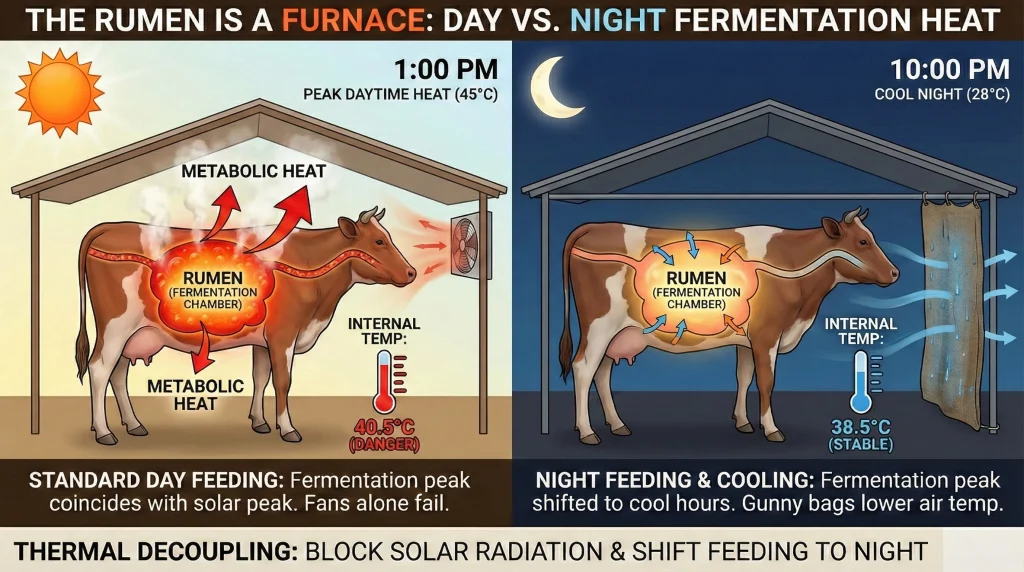
The rumen hosts billions of microbes breaking down fibre through fermentation. This process releases heat continuously. When a cow consumes bulky dry fodder or concentrates during the late morning, fermentation heat peaks roughly three to four hours later. In Birbhum, that peak coincides exactly with the hottest part of the day. This overlap is called thermal stacking. Once it begins, external cooling measures struggle to compensate.
Scientific studies on ruminant thermoregulation confirm that dry matter intake during hot periods directly increases metabolic heat load and suppresses subsequent feed intake and milk synthesis. The cow reduces eating to protect herself, not because feed quality is poor.
The Core Rule: Starve the Fire by Day, Feed the Fire by Night
Heat stress management is not about adding equipment. It is about timing biology.
At Terragaon Farms, we intentionally reduce rumen activity during peak solar hours and shift fermentation to cooler night periods. This single change stabilised respiration rates and prevented catastrophic intake drops.
Protocol One: Cool Water Is Non-Negotiable
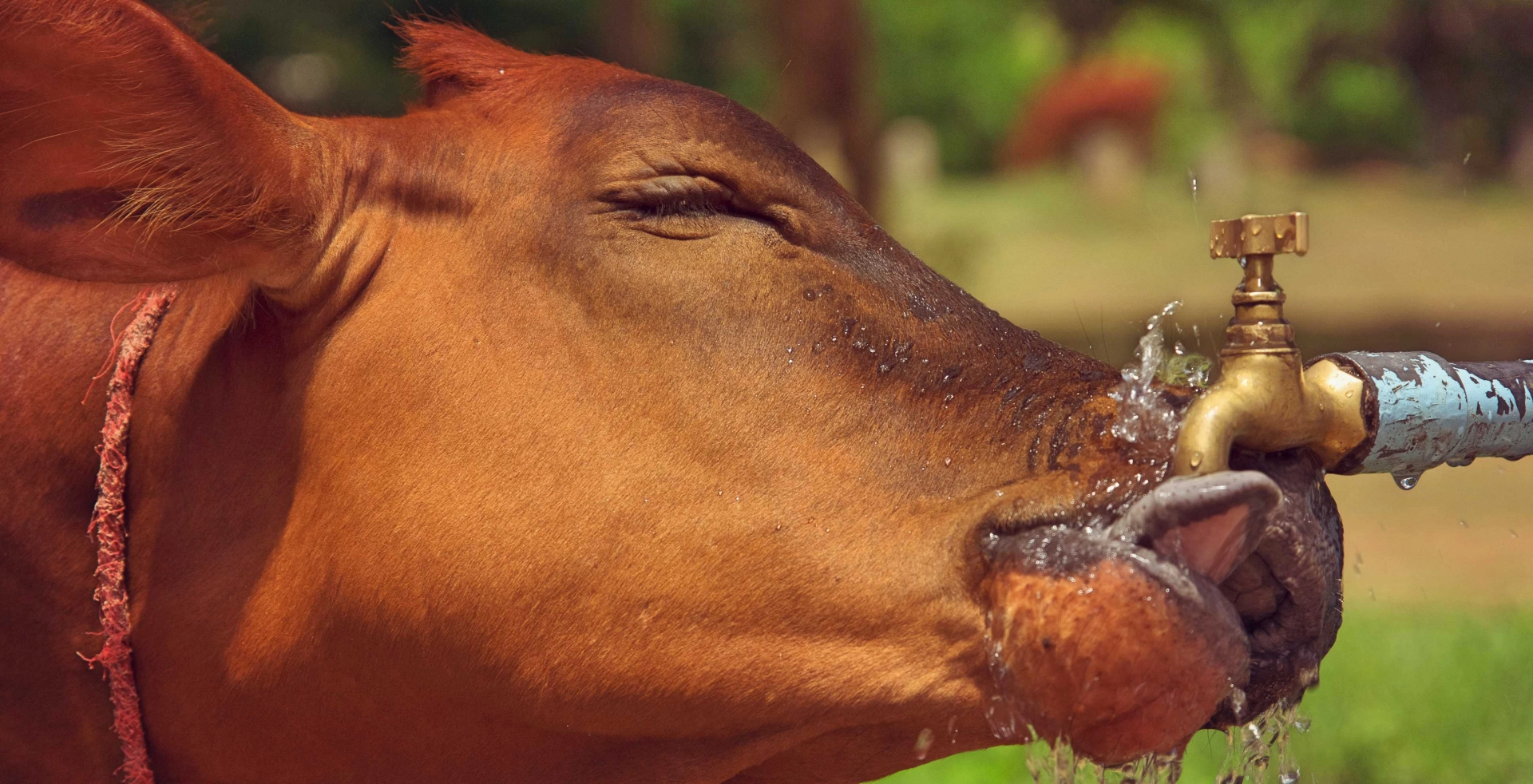
Water is the cow’s primary cooling mechanism. However, in Birbhum, water stored in exposed tanks frequently reaches 35–40°C by noon. Drinking hot water does not cool the core.
We corrected this by burying supply lines, covering tanks with white lime-coated jute sacks, and keeping water shaded at all times.
The target is simple. Drinking water must remain below 25°C.
Field observation shows that cows consuming cool water reduce core temperature by approximately 0.5°C within twenty minutes. This reduction directly improves feed intake later in the day.
Protocol Two: The Gunny Bag Cooler, Not the Fogger
High-pressure foggers are aggressively marketed, but in eastern India they often backfire. During humid pre-monsoon conditions, foggers raise relative humidity and increase wet-bulb temperature, which reduces the cow’s ability to lose heat through respiration and sweating.
Our alternative is deliberately low-tech.
Gunny bags are hung on the windward side of the shed. A simple drip line keeps them continuously wet. Hot air passes through the wet jute, loses heat through evaporation, and enters the shed cooler without saturating the air.
Measured temperature drop ranges from 5°C to 8°C. When outside temperatures reach 42°C, shed temperatures remain near 34°C.
The total cost is under ₹600, making this accessible to smallholders.
Protocol Three: Chrono-Nutrition, Feeding by the Clock
In 2024, we completely inverted our feeding schedule to match thermal reality.
| Time | Activity | Feed | Biological Logic |
|---|---|---|---|
| 5:00 AM | Milking | Green fodder + concentrate | Quick energy before heat rises |
| 10:00 AM | Rest | No feed | Prevent fermentation at noon |
| 12:00 PM | Cooling | Electrolyte water | Replace sweat losses |
| 6:00 PM | Main feeding | Dry straw + green fodder | Fermentation peaks at night |
| 10:00 PM | Supplement | Mineral mixture | Replenish salts |
This schedule ensures that the rumen’s heat output peaks when ambient temperatures are lowest.
Failure Log: The Afternoon Bath Mistake (May 2023)
In an attempt to cool cows, we washed them with hose water at 1 PM. The water evaporated quickly from the skin, but humidity trapped under the shed roof spiked sharply. Within thirty minutes, respiration rates rose from 60 to over 90 breaths per minute.
The lesson was immediate and permanent. A wet cow in hot, still air does not cool. She steams.
Washing or sprinkling is only safe when airflow is strong enough to dry the animal immediately. Otherwise, it worsens heat stress.
Measured Impact on Milk Loss (2025 Cycle)
Comparison during peak summer, May 15–30, in Sahiwal cows.
| Management Style | Milk Drop |
|---|---|
| Standard daytime feeding + fans | 35 percent |
| Night feeding + gunny cooling | 12 percent |
The cost of intervention was approximately ₹25 per day in additional labour and electricity. The value of milk saved averaged ₹140 per day per cow.
The economics were decisive.
The Reproductive Cost Most Farmers Miss
Heat stress does not only reduce milk. It suppresses ovulation and conception. Cows under chronic heat stress show silent heats, poor embryo survival, and delayed calving intervals.
When a cow stops cycling in summer, the loss is not visible immediately. It appears next year as a missing calf.
Conclusion: Respect the Thermal Ceiling
A cow is not a machine with infinite tolerance. She is a mammal carrying a fermentation furnace inside her abdomen. In Indian summers, your responsibility is not to force production but to prevent metabolic collapse.
If heat stress is ignored, the cow protects herself in two ways. She stops eating. She stops reproducing.
You lose milk today.
You lose the herd tomorrow.
Frequently Asked Questions (FAQs)
Why do fans alone not cool cows
Because they do not reduce internal fermentation heat.
When does rumen heat peak
Three to four hours after feeding.
Is night feeding safe
Yes, and it significantly reduces summer heat stress.
Are foggers bad for cows
In humid climates, yes, they can worsen heat stress.
What is a danger zone for cows
Above 30°C temperature combined with over 70 percent humidity.
Next Step
Field Action: Buy a simple digital thermometer/hygrometer (₹300). Hang it in your cow shed at animal height. If the temperature is above 30°C and humidity is above 70%, your cows are in the “Danger Zone.”

Krittika Das is a field practitioner and primary author at Terragaon Farms in Birbhum, West Bengal. Her writing is grounded in daily farm work, long-term soil observation, and small-land realities of eastern India. She focuses on natural farming, soil ecology, ethical dairy, and low-input systems, translating field experience into clear, practical knowledge for farmers and conscious food consumers.