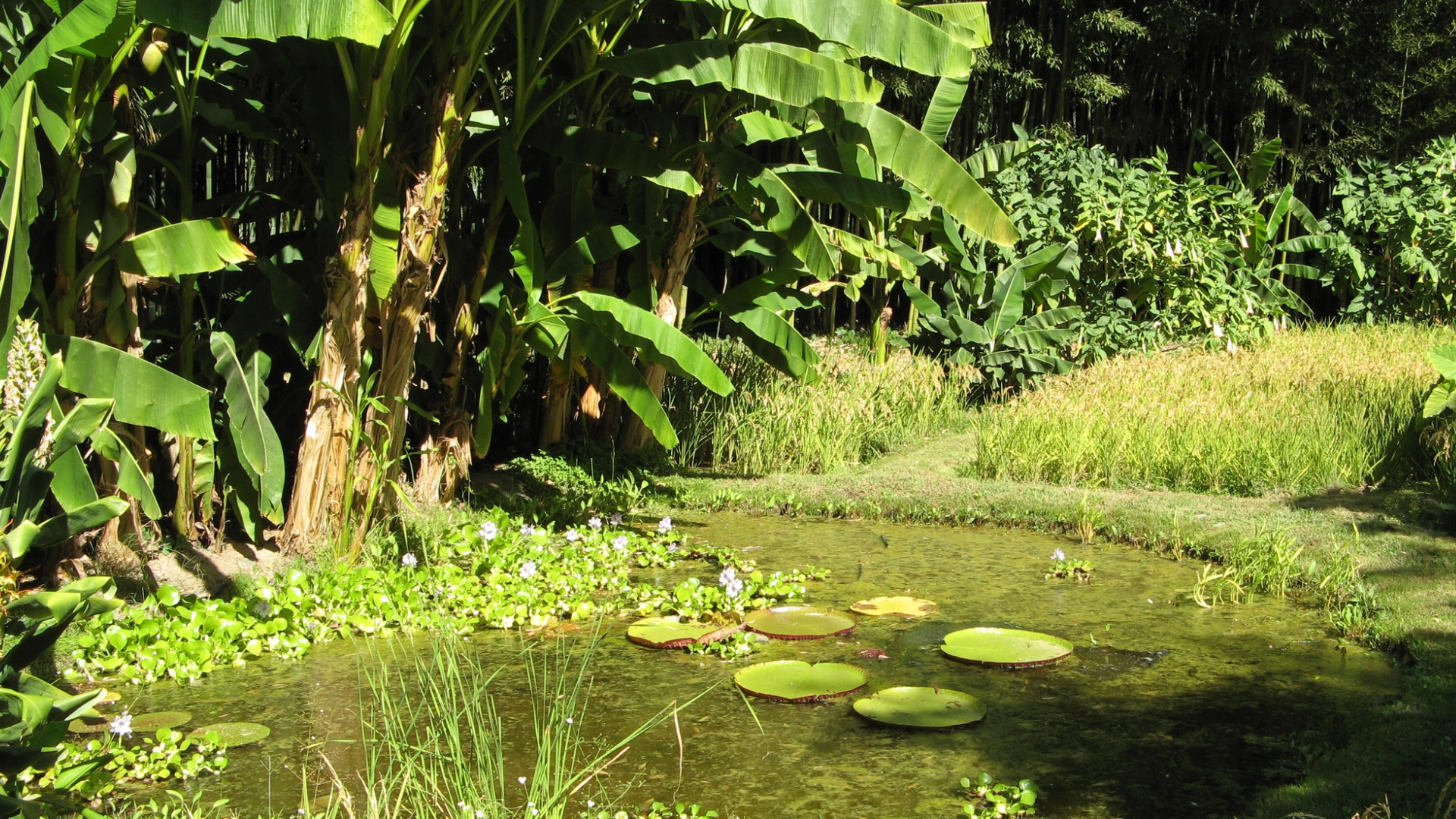
A Banana Circle is not a planting trick. It is a passive biological water-treatment and nutrient-recovery system designed for small farms in West Bengal. It safely absorbs household greywater and kitchen waste without electricity, without chemicals, and without contaminating groundwater, while converting that waste stream into food and micro-climate control. At Terragaon Farms in Birbhum, Banana Circles replaced open drains, eliminated stagnant wastewater zones, saved over fourteen thousand litres of freshwater annually per unit, and produced higher banana yields than field planting. In lateritic landscapes, a Banana Circle closes a critical leak in the farm’s energy and water economy.
Why Greywater Is a Hidden Liability on Small Farms
Most rural houses discharge kitchen and bathing water into open soil. In Birbhum’s laterite, this creates three problems simultaneously. Water evaporates quickly, nutrients are lost, and stagnant patches become mosquito breeding zones. Greywater is not toxic by default, but unmanaged discharge converts it into pollution.
Current sanitation research confirms that decentralised biological filtration systems outperform soak pits in hot climates when organic loading is moderate and oxygen pathways are maintained. The Banana Circle functions as such a system, built entirely from soil and biomass.
The Physics of the Banana Circle
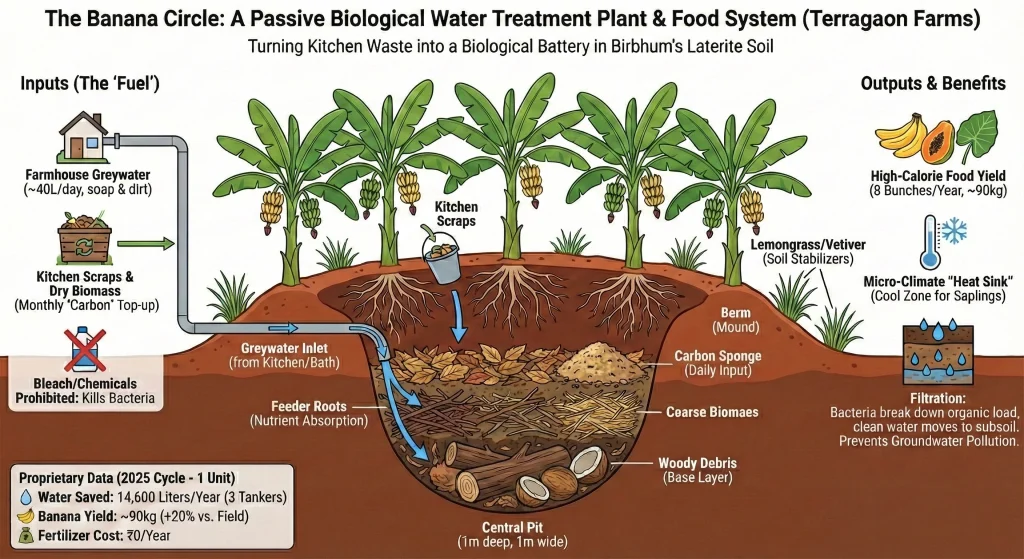
A Banana Circle creates a sub-surface wetland in otherwise dry soil.
The central pit remains permanently filled with coarse carbon material. This material acts as a sponge, holding water and air simultaneously. Greywater enters slowly and is filtered through aerobic and anaerobic microbial layers before reaching surrounding soil. Bananas and companion plants extend feeder roots into this zone, extracting nutrients and moisture directly.
The system works because it never becomes hollow. Structure, not depth, is the controlling factor.
Construction Anatomy
The Banana Circle consists of a central pit and a surrounding berm.
The pit receives waste and water.
The berm supports food plants.
The biomass maintains airflow and microbial balance.
This separation prevents root suffocation while maximising nutrient capture.
Construction Protocol
Labour requirement is approximately one man-day. Tools required are a spade and crowbar for lateritic layers.
A circular area of two metres diameter is marked. A bowl-shaped pit is excavated in the centre, roughly one metre deep and one metre wide. Excavated soil is piled around the rim to form a raised berm. Five to seven banana suckers or papaya are planted on the berm, not inside the pit. Lemongrass or vetiver is planted on the outer slope to stabilise soil during monsoon.
The pit is filled completely with coarse organic matter such as twigs, coconut husks, dry leaves, and straw. It must be heaped above ground level, as settling will occur. A trench or pipe directs kitchen and bathing water directly into the pit.
What Goes Into the Circle
Daily inputs include kitchen rinse water, vegetable scraps, and bathing water. Monthly inputs include fresh dry biomass to maintain structure.
Prohibited inputs include chlorine bleach, phenyl cleaners, toilet chemicals, and plastic. These disrupt microbial populations and collapse filtration.
Maintenance Rule: Feed the Carbon
A Banana Circle is a living digester, not a soak pit. If the pit becomes hollow or sludge-like, oxygen pathways collapse and anaerobic smell develops. Dry carbon must always dominate volume.
This single rule determines success or failure.
Failure Log August 2024
In Circle Number Three near the farmhouse kitchen, dry biomass addition was neglected for three months. The pit hollowed, greywater pooled, and anaerobic sulphur smell appeared. Mosquito larvae were observed.
Correction involved adding fifty kilograms of dry sawdust and twigs. Odour disappeared within twenty-four hours and insect activity ceased.
Lesson confirmed. A Banana Circle must remain structurally full at all times.
Yield and Filtration Data (2025 Cycle)
One Banana Circle with seven Kanthali banana plants received approximately forty litres of greywater daily.
| Metric | Observed Value | Comparison |
|---|---|---|
| Water reused | 14,600 L/year | Equal to 3 tanker loads |
| Banana yield | ~90 kg (8 bunches) | 20% higher than field bananas |
| Fertiliser cost | ₹0 | Field bananas ~₹400/year |
| Odour and surface runoff | None | Open drains persistent |
| Soil residue effect | No visible soap accumulation | Microbial breakdown effective |
Research on greywater biodegradation supports this observation when surfactants are mild and carbon input is maintained.
Micro-Climate Advantage
Beyond waste treatment and food, the Banana Circle functions as a heat sink. Seven mature banana plants transpire heavily during peak summer. In May, measured shade temperature around the circle was consistently lower than adjacent open ground. Heat-sensitive nursery seedlings were successfully maintained in this micro-climate without additional watering.
In hot climates, transpiration is cooling infrastructure.
Interpreting the System as a Biological Battery
The Banana Circle stores water, nutrients, and carbon in slow-release form. Instead of exporting waste and importing fertiliser, energy is buffered on site. This is why it behaves like a battery rather than a disposal unit.
Waste is not eliminated.
It is delayed, transformed, and reused.
Ground Reality Trade-Offs
Banana Circles require labour and discipline. They cannot be ignored like soak pits. They are unsuitable where chemical cleaners are unavoidable. They must be placed downhill from drinking water sources.
These constraints are manageable, but they are non-negotiable.
Conclusion
Greywater leaving a house is not a sanitation problem. It is a systems failure.
In regions where groundwater drops annually and fertiliser prices rise unpredictably, allowing water and nutrients to escape untreated is self-sabotage. A Banana Circle converts a liability into infrastructure.
Capture what leaves your house.
Feed what feeds you.
Frequently Asked Questions (FAQs)
What is a Banana Circle used for
It treats household greywater biologically and converts it into food and soil moisture.
Is a Banana Circle safe for groundwater
Yes, when carbon volume is maintained and chemical cleaners are avoided.
Can this work in lateritic soil
Yes. It performs best in fast-draining laterite where evaporation losses are high.
What plants grow best in a Banana Circle
Banana, papaya, colocasia, turmeric, lemongrass, and vetiver.
How often does it need maintenance
Dry biomass should be added monthly or whenever the pit volume drops.
Next Step
Field Action: Walk around your house. Locate the pipe where your kitchen sink or bathing water exits. Is it creating a muddy puddle? That puddle is your future Banana Circle.

Krittika Das is a field practitioner and primary author at Terragaon Farms in Birbhum, West Bengal. Her writing is grounded in daily farm work, long-term soil observation, and small-land realities of eastern India. She focuses on natural farming, soil ecology, ethical dairy, and low-input systems, translating field experience into clear, practical knowledge for farmers and conscious food consumers.