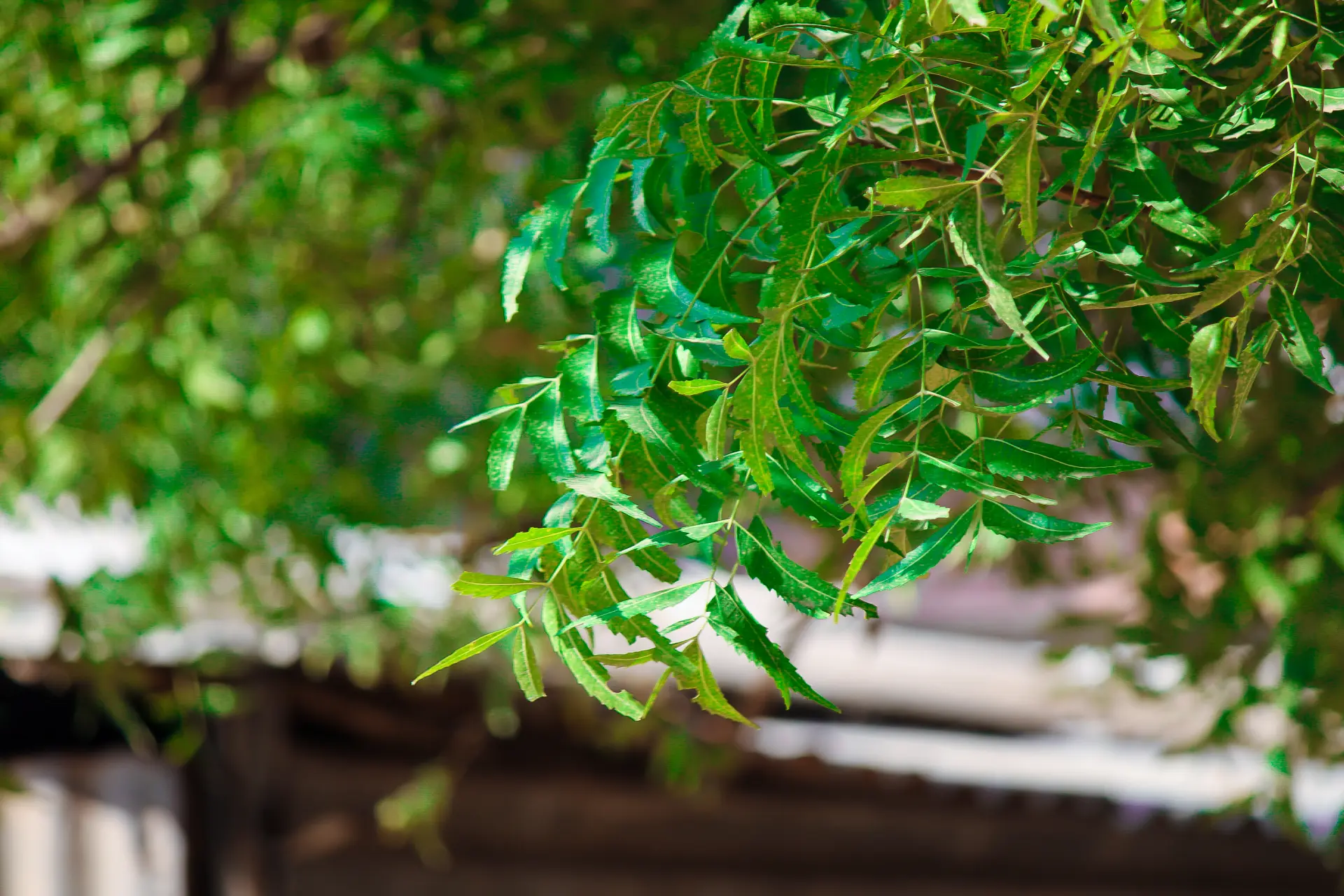
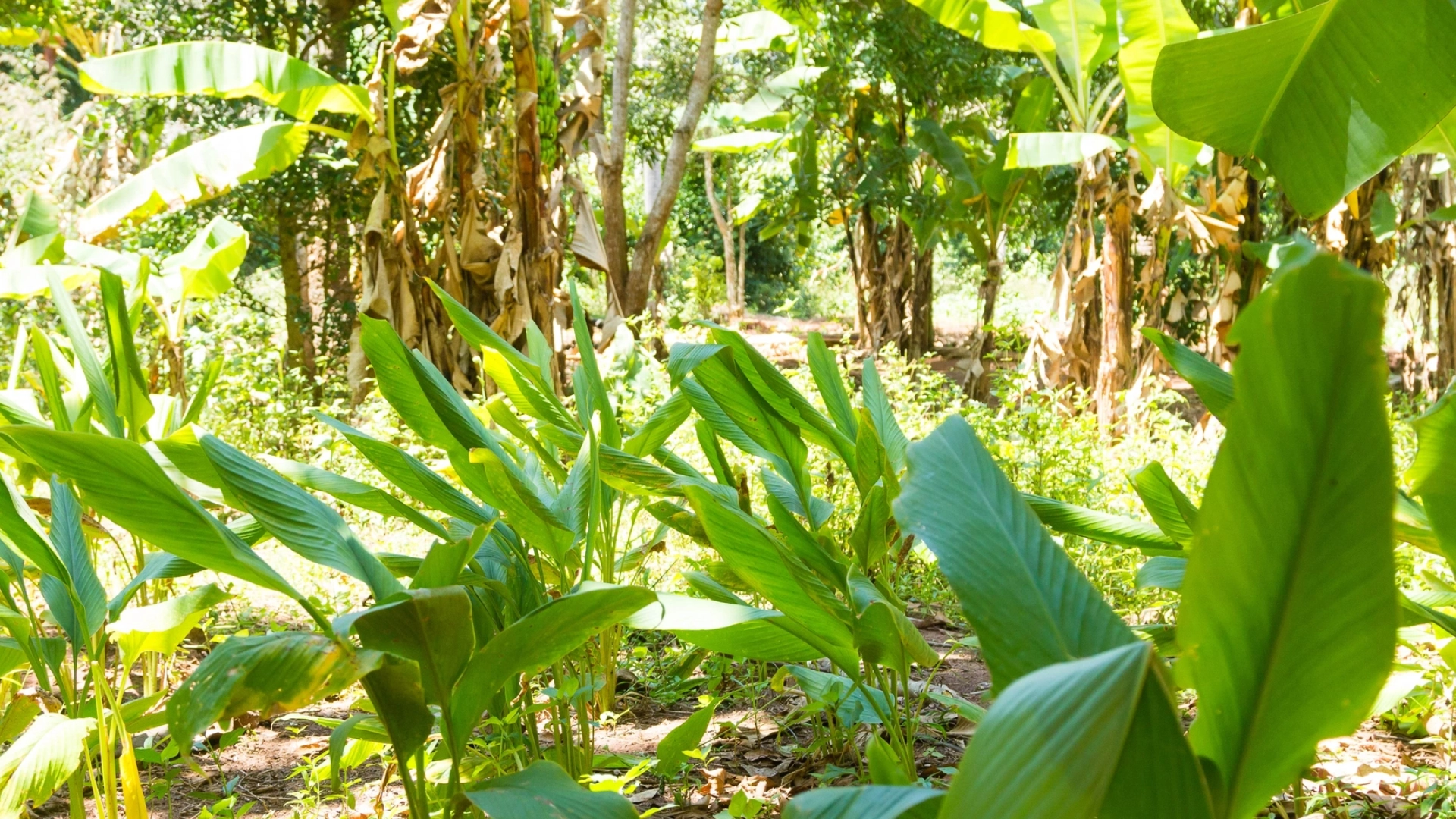
The shaded zone beneath a mature Banana Circle is not wasted space. In Birbhum’s lateritic climate, it is the most thermally stable and biologically productive micro-site on the farm. When open soil temperatures exceed 55–60°C in May, soil beneath the banana canopy consistently remains between 26–30°C. This temperature window allows high-value rhizomes such as turmeric, ginger, and arrowroot to survive without artificial shade or irrigation. At Terragaon Farms, these crops are not planted inside the waste pit but precisely zoned along the berm slopes, forming a spice guild where bananas provide shade and humidity while the rhizomes function as living mulch that protects banana feeder roots. This system converts sanitation infrastructure into a perennial spice asset.
Why the Banana Circle Creates a Unique Micro-Climate
Banana plants transpire heavily and cast broad, overlapping leaves. Research on agroforestry and multistorey cropping confirms that dense canopies reduce incoming solar radiation, slow wind speed, and lower soil surface temperature by 20–30°C compared to bare ground. In a Banana Circle, this effect is intensified by constant sub-surface moisture from greywater infiltration. The result is a stable, humid micro-climate that mimics forest understory conditions, which rhizomatous spices evolved to occupy.
Zoning the Berm: Spatial Logic of the Guild
Random planting inside a Banana Circle fails. Each crop must be matched to moisture gradient and drainage characteristics.
Zone A: The Ridge (Top of the Berm)
This zone remains the driest and most structurally stable.
Occupants are banana and papaya. Their role is canopy formation and root anchoring. Their roots stabilise the berm and prevent collapse during monsoon rain.
Zone B: The Inner Slope (Facing the Pit)
This zone experiences periodic saturation and anaerobic conditions.
Occupants are colocasia and water spinach. These plants tolerate wet feet and actively draw nutrients from the greywater-rich zone. Rhizomes such as ginger or turmeric will rot here rapidly.
Zone C: The Outer Slope (Facing the Field)
This is the prime spice zone.
It is shaded, well aerated, and well drained. Excess water moves downslope during heavy rain, preventing rhizome rot while humidity remains high due to canopy cover.
Species Selection and Agronomic Rationale
Turmeric (Curcuma longa)
Varieties used include Lakadong and Megha Turmeric-1 due to high curcumin content and disease tolerance.
Turmeric is planted on the east and north-facing slopes to avoid harsh afternoon sun. It is planted at a depth of approximately 3 inches with close spacing. Turmeric tolerates intermittent moisture stress better than ginger, making it the safest entry crop for beginners.
Ginger (Zingiber officinale)
The Nadia variety is preferred for its low fibre and strong pungency.
Ginger is planted strictly on the south and west-facing outer slopes where shade is densest. Soil must be loose and well drained. At Terragaon Farms, we amend ginger pockets with approximately 30 percent sand to prevent waterlogging. Ginger is highly susceptible to Pythium-induced rhizome rot, especially under stagnant conditions.
Arrowroot (Maranta arundinacea)
Arrowroot functions as the resilience crop of the guild.
It is planted at the lowest tier of the outer slope. It is pest resistant, drought tolerant, and survives conditions that often wipe out ginger. Arrowroot starch provides a food-security buffer when other spices fail.
Planting Protocol: Pre-Monsoon Precision
Planting is timed between April 15 and May 15, just before consistent monsoon rainfall.
Seed Treatment
Rhizomes are common carriers of fungal pathogens. Every seed piece is treated.
Rhizomes are soaked for thirty minutes in a solution containing Trichoderma viride at 10 g per litre and Pseudomonas fluorescens at 10 g per litre. This practice is supported by plant pathology research showing reduced rhizome rot and improved early vigour. Rhizomes are shade-dried for two hours before planting.
Planting and Mulching
Small pits are dug along the berm slope. A handful of vermicompost mixed with neem cake is added to repel nematodes. Rhizomes are placed flat with buds facing upward, covered lightly with soil, and immediately mulched with dry leaves.
Earthing Up
During July and August, as rhizomes expand upward, soil is scraped gently from the berm base and layered over exposed rhizomes twice. Earthing up increases rhizome mass and prevents greening.
Failure Log From the 2024 Cycle
In Circle Number Five, ginger was planted on the inner slope to maximise space use. A heavy July storm caused pit overflow and forty-eight hours of water stagnation. One hundred percent of ginger rotted within a week. The loss confirmed a non-negotiable rule.
Spices must remain outside the saturation zone. Wet-zone crops and spice crops cannot share space.
Economic Contribution of the Spice Guild
A single Banana Circle occupies roughly seven square metres of space yet produces measurable value.
| Crop | Fresh Yield | Average Market Rate | Gross Value |
|---|---|---|---|
| Turmeric | 3.0 kg | ₹40 per kg | ₹120 |
| Ginger | 1.5 kg | ₹120 per kg | ₹180 |
| Colocasia | 5.0 kg | ₹30 per kg | ₹150 |
| Total | ₹450 |
This income is generated without additional land, fertiliser purchase, or irrigation. It is a byproduct of waste management infrastructure.
Visual Logic for Infographics
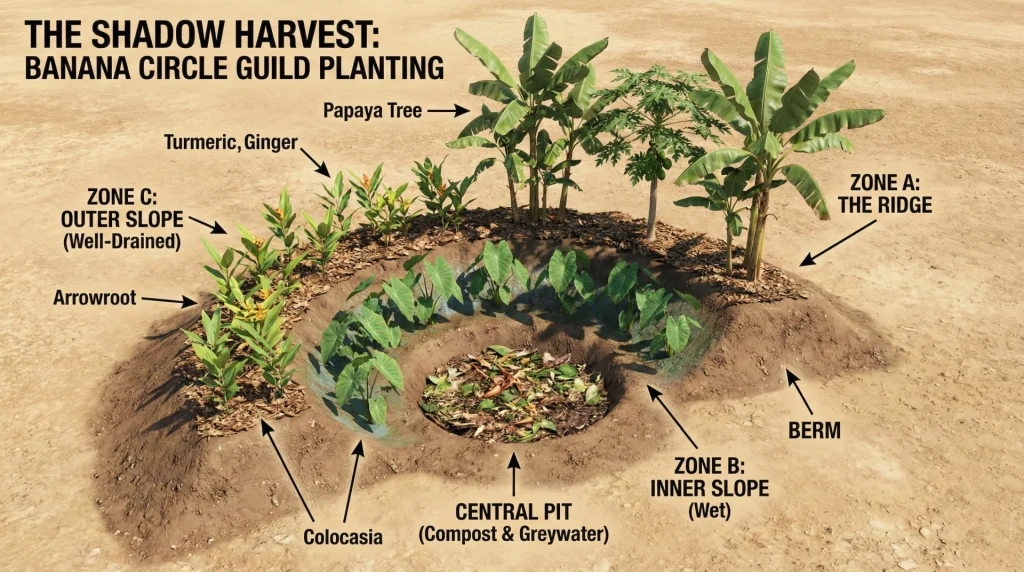
A circular diagram showing the pit at the center, banana ring on the ridge, Colocasia on the inner slope, and spice rhizomes on the outer slope communicates this system clearly. A temperature comparison bar chart contrasting open soil at 60°C with Banana Circle soil at 28°C reinforces the micro-climate argument.
Strategic Insight: The Shadow Economy
The Banana Circle spice guild demonstrates a broader principle. Yield does not only come from fields. It comes from intelligently designed edges, shadows, and overlaps. In high-heat regions, shade is capital.
Conclusion
The space beneath a Banana Circle is not marginal. It is elite real estate. When zoned correctly, it supports a spice guild that survives extreme heat, suppresses weeds, protects banana roots, and generates income from land that would otherwise grow nothing. This is not companion planting. It is micro-climate engineering.
Frequently Asked Questions (FAQs)
Can ginger and turmeric grow under banana shade
Yes, when planted on the well-drained outer slope of a Banana Circle.
Why do spices rot inside Banana Circles
Because the inner slope remains waterlogged and anaerobic.
Is arrowroot necessary
It provides resilience and food security when ginger fails.
Does this system need fertiliser
No. Nutrients are supplied through greywater, mulch, and biological activity.
Next Step
Field Action: Do you have access to fresh Trichoderma viride powder? It is essential for ginger survival. Check the manufacturing date—if it is older than 6 months, the spores are dead.

Krittika Das is a field practitioner and primary author at Terragaon Farms in Birbhum, West Bengal. Her writing is grounded in daily farm work, long-term soil observation, and small-land realities of eastern India. She focuses on natural farming, soil ecology, ethical dairy, and low-input systems, translating field experience into clear, practical knowledge for farmers and conscious food consumers.