The “Breaker Enzyme” slurry is a purpose-built, fungal-dominant microbial inoculant used only during the first twelve months of soil regeneration in Birbhum’s lateritic zones. Its sole function is to accelerate the decomposition of woody biomass placed inside sub-soiler rip lines so that those fractures do not reseal into dry air pockets that kill roots. Unlike Jeevamrut, which functions as a general soil tonic, this slurry is anaerobic, lignin-targeted, and applied only once immediately after mechanical ripping and biomass stuffing. This is not a fertility input. It is a structural intervention.
Why Mechanical Ripping Fails Alone in Laterite
In Birbhum’s laterite soils, mechanical ripping without biological follow-through is temporary. Field observations from 2023 showed that cracks created at approximately one and a half feet resealed within thirty days of monsoon rainfall. The laterite collapses back into itself, reforming the hardpan and nullifying the intervention. Stuffing cracks with dry biomass delays collapse, but dry biomass in dry laterite does not decompose. It mummifies. Without forced decomposition, those rip lines become root-killing voids. The problem is not cracking the soil. The problem is keeping it open biologically.
The Biological Mechanism Behind the Slurry
Woody biomass such as paddy straw and stalks contains high lignin and cellulose. In hot, oxygen-poor lateritic subsoil, decomposition stalls unless lignolytic fungi are present in high concentration. The Breaker Enzyme slurry introduces a dense, anaerobic, fungus-favouring microbial population that immediately colonises the buried biomass. As decomposition begins, the biomass converts into a carbon sponge that holds moisture and physically prevents hardpan resealing. This turns a mechanical fracture into a biological channel. The objective here is not yield acceleration. It is beating oxidation and structural collapse.
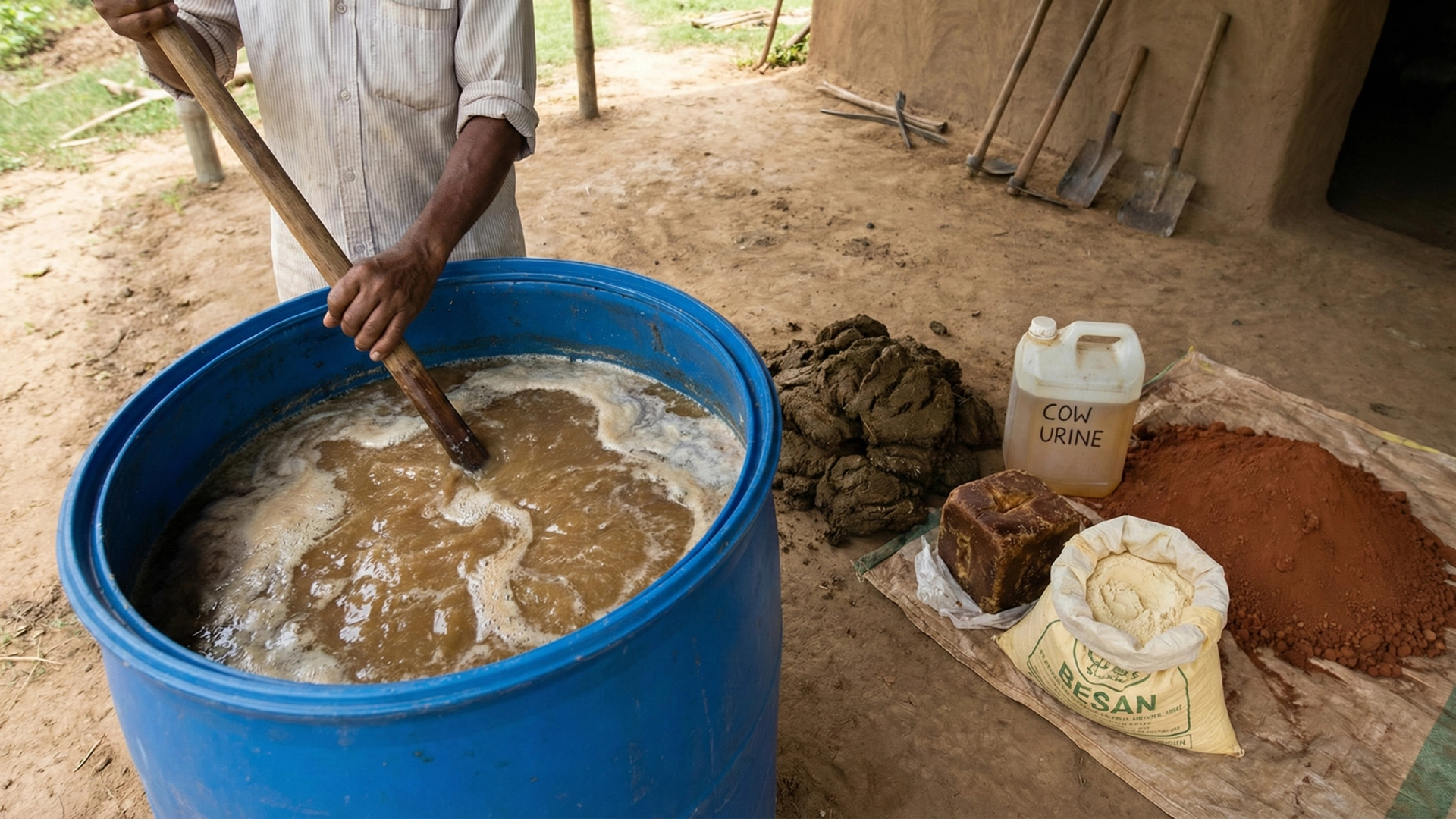
The Breaker Enzyme Concentrate Recipe (200 Litres)
This formulation is location-specific and not a general bio-input. Ingredient substitution alters function.
| Ingredient | Quantity | Role | Notes |
| Water | 180 Liters | Carrier | Must be dechlorinated (pond/borewell). |
| Fresh Desi Cow Dung | 10 kg | Nitrogen Source | Must be <2 days fresh. |
| Cow Urine (Gomutra) | 5 Liters | Anti-fungal/N-Booster | Aged urine is preferred. |
| Jaggery (Gur) | 2 kg | Microbial Energy | Black, chemical-free jaggery only. |
| Besan (Chickpea Flour) | 2 kg | Protein Source | Can substitute with any pulse flour. |
| Termite Mound Soil | 2 kg | The Catalyst | Contains native cellulase enzymes. |
| Forest Soil | 1 handful | Diversity Inoculum | From under an old Banyan/Peepal tree. |
Preparation Protocol
All preparation must occur in shade.
- Mix all solid ingredients in a bucket with urine to form a paste.
- Dissolve the paste in the water drum.
- Cover with a jute sack (breathable).
- Fermentation: Keep in shade for 7 days. Stir clockwise twice daily.
- Ready State: The smell changes from foul to sweet/fruity. A white fungal layer will form on top.
Application Protocol: Drench and Cover Method
This is a high-labor, time-sensitive operation. It must be timed with your mechanical intervention.
Step 1: The Rip Run the sub-soiler. Create rip lines 4 feet apart.
Step 2: The Stuffing Immediately push dry biomass (straw/leaves) into the open rip lines. Do not wait.
Step 3: The Drench Pour the “Breaker Enzyme” slurry directly onto the biomass in the rip lines.
- Rate: Pour until the biomass is soaked.
- Target: You are targeting the buried carbon, not the surface soil.
Step 4: The Seal Cover the treated rip lines with topsoil immediately to prevent UV sterilization of the microbes.
Failure Log June 2024
Location was Plot B-4, one acre. The error was applying slurry before stuffing biomass. The slurry dried in 42°C heat, microbes died, and biomass inserted later did not decompose for eight months. The lesson was absolute. The slurry must touch biomass first and be buried immediately.
Cost Reality Per Acre
Cow dung and urine were farm-sourced. Jaggery cost approximately ₹120. Besan cost ₹160. Labour required one man-day costing ₹350. Total operational cost averaged ₹630 per acre. This costs less than a single bag of urea and creates permanent structural change rather than seasonal dependency.
Boundary Conditions and Warnings
This slurry is not a replacement for compost, Jeevamrut, or fertility inputs. It is not for annual application. Repeated use without ripping causes anaerobic damage. This is strictly a Year One intervention. Misuse turns biology into rot.
Final Position of Terragaon Farms
Lateritic hardpan does not fail due to nutrient deficiency. It fails due to biological absence under extreme heat. The Breaker Enzyme slurry does not regenerate soil by itself. It buys time by keeping fractures open long enough for natural systems to establish. You cannot force soil to heal. You can only stop it from collapsing while it heals.
Frequently Asked Questions
What is the Breaker Enzyme slurry used for
It is used to accelerate decomposition of woody biomass placed inside sub-soiler rip lines during early soil regeneration.
Is this the same as Jeevamrut
No. Jeevamrut is a general microbial tonic. This slurry is anaerobic, fungal-dominant, and structure-specific.
How often should this slurry be applied
Only once during the first year immediately after mechanical ripping.
Can this replace fertilizers
No. It alters soil structure, not nutrient supply.
Why is termite mound soil used
It contains native cellulose-degrading microbes adapted to hard woody material.
A Next Step
Field Action: Locate a termite mound on your property or a neighbor’s land. Collect 2 kg of the soil from the base (not the active top). This soil is rich in the specific gut bacteria of termites that dissolve hard wood.

Krittika Das is a field practitioner and primary author at Terragaon Farms in Birbhum, West Bengal. Her writing is grounded in daily farm work, long-term soil observation, and small-land realities of eastern India. She focuses on natural farming, soil ecology, ethical dairy, and low-input systems, translating field experience into clear, practical knowledge for farmers and conscious food consumers.