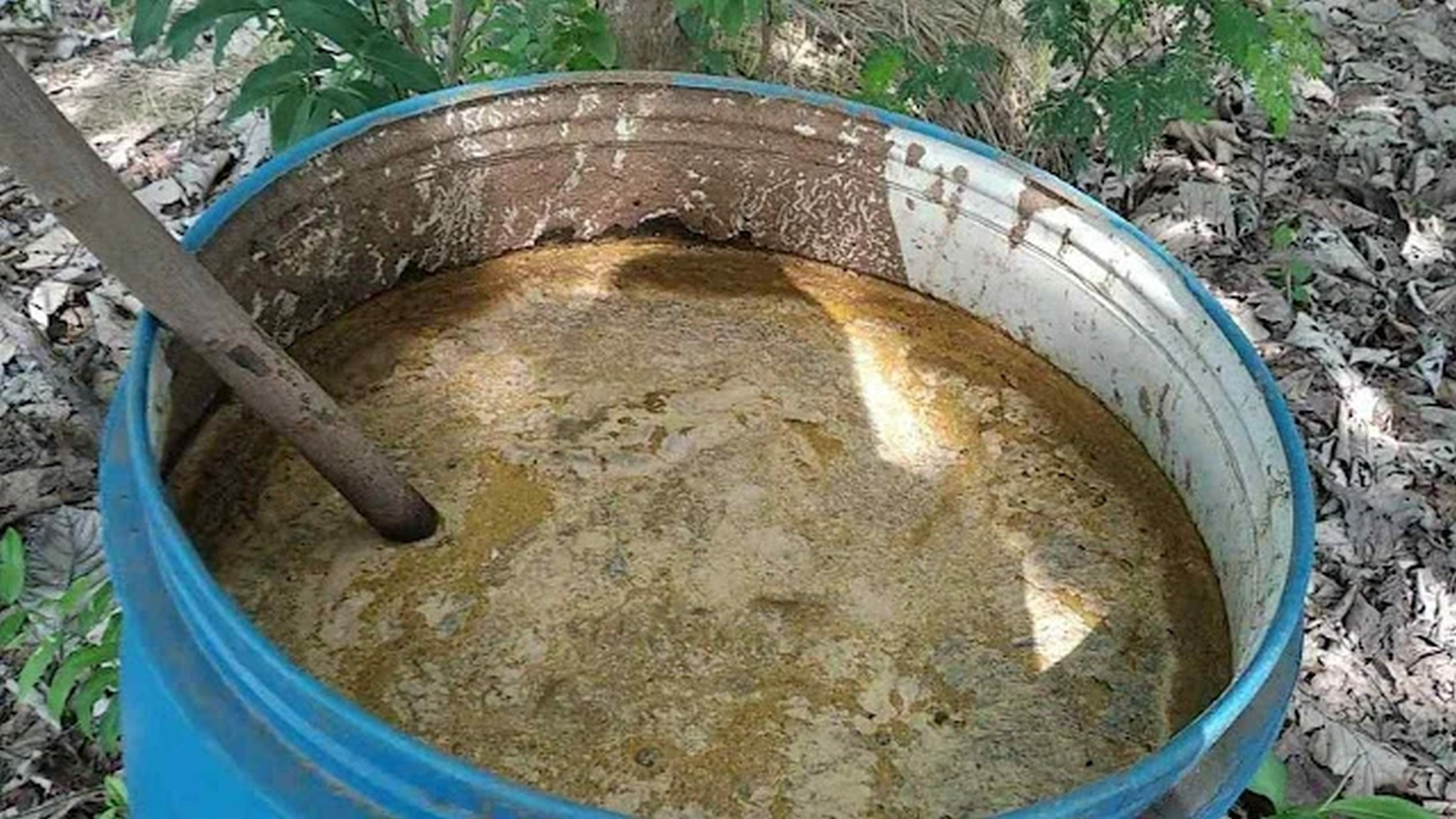
In the lateritic zones of Birbhum, applying liquid biofertilizers such as Jeevamrut to dry soil is biologically ineffective and economically wasteful. Soil microbes are moisture-dependent organisms. When soil moisture falls below roughly 10–12 percent, which is common from March to May, microbes introduced through Jeevamrut experience rapid desiccation and osmotic stress. Under surface temperatures of 40–45°C, most die within minutes. Field observations at Terragaon Farms confirm that Jeevamrut applied to dry soil produces no measurable improvement in plant vigor or soil condition, while the same input applied to pre-wetted soil shows visible biological response within days. Jeevamrut does not “wait” in soil. It lives or it dies.
Why Liquid Microbes Cannot Survive Dry Soil
Modern soil biology research is clear on one point. Microbial movement, nutrient exchange, and root colonisation require a continuous water film around soil particles. Without this film, microbes cannot migrate, respire efficiently, or access root exudates.
Chemical fertilisers can remain inert in dry soil. Living organisms cannot.
In Birbhum’s laterite, dry soil pores act like a hot vacuum. Water from the slurry evaporates immediately, leaving microbes stranded and exposed to oxygen and heat. Oxidative damage follows rapidly.
This is not poor technique. It is physics and physiology.
The Water Film Rule
The effectiveness of Jeevamrut depends on one condition only. The presence of a stable moisture film.
When soil is wet, water acts as a biological highway. Microbes move toward roots and exchange nutrients for sugars. When soil is dry, the highway collapses. No movement, no colonisation, no benefit.
This is why Jeevamrut behaves very differently across seasons even when prepared correctly.
Field Observation From Terragaon Farms
During the 2024 dry season, Jeevamrut was applied to two adjacent plots using the same batch.
One plot had soil moisture around 8 percent. The other was irrigated the previous evening.
After fourteen days, the dry plot showed no change in leaf colour, soil smell, or aggregation. The pre-wetted plot showed increased vegetative growth and darker, biologically active soil within five days.
The difference was not the input. It was water.
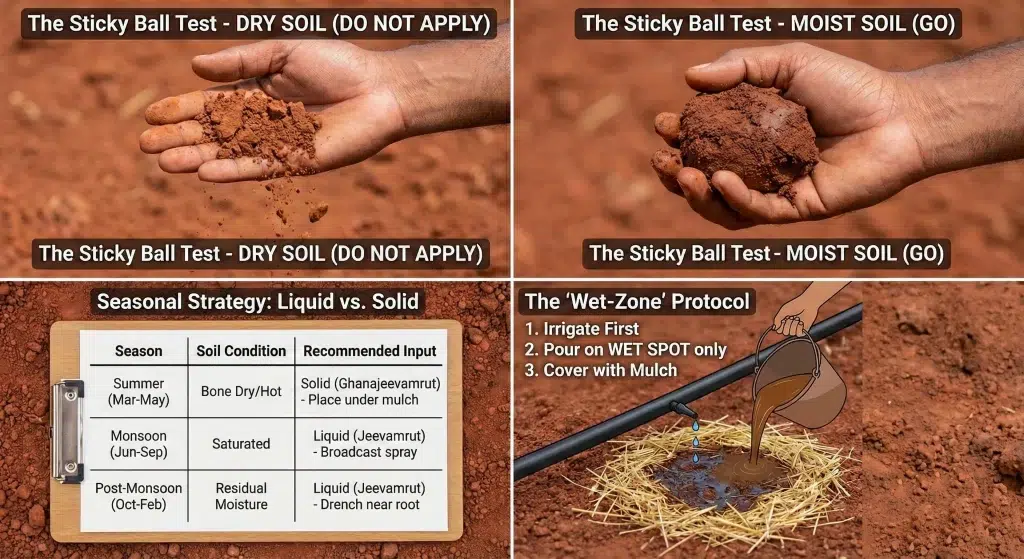
The Sticky Ball Test: A Field-Ready Moisture Check
We do not rely on moisture meters in daily operations. We rely on soil behaviour.
Go two inches below the surface or mulch layer. Take a handful of soil and squeeze firmly.
If it crumbles instantly, stop. Soil is too dry. Do not apply Jeevamrut.
If it forms a weak ball that breaks easily, conditions are suitable for immediate drenching.
If water oozes out, wait. The soil is anaerobic. Allow drainage for twenty-four hours.
This simple test prevents labour and material loss.
Seasonal Strategy for Jeevamrut in West Bengal
We adjusted standard protocols to match the climate reality of Birbhum.
| Season | Typical Soil Condition | Recommended Input | Application Logic |
|---|---|---|---|
| Monsoon Jun–Sep | Saturated | Liquid Jeevamrut | Broadcast with rain or irrigation |
| Post-monsoon Oct–Feb | Residual moisture | Liquid Jeevamrut | Targeted drench near roots |
| Summer Mar–May | Bone dry, hot | Ghanajeevamrut | Place solid cakes under mulch |
This seasonal separation is supported by microbial ecology research. Dormant spores survive dryness. Active cultures do not.
Why Solid Inoculants Work in Summer
Ghanajeevamrut functions as a microbial bank. Microbes are present in dormant or spore form, protected within dried organic matter. They do not attempt to grow until moisture returns.
When light irrigation or an unseasonal storm occurs, activation happens locally and gradually. This avoids the mass die-off seen with liquid inputs.
In hot climates, dormancy is survival.
Failure Log April 2024
In Vegetable Block C, Jeevamrut was foliar sprayed at ten percent concentration during a cloudy afternoon. Relative humidity was approximately twenty-five percent.
Leaves dried within two hours. By the third day, forty percent of the crop showed leaf scorching.
The cause was rapid evaporation that concentrated salts and organic acids on leaf surfaces. Microbes died instantly. Stomata were damaged.
Lesson reinforced. Foliar spraying in Birbhum is only safe when humidity exceeds sixty percent, typically early morning or during monsoon.
The Wet-Zone Protocol for Emergencies
If liquid inputs must be used during dry months, application must be restricted to hydrated micro-zones.
Irrigate first, allowing water to penetrate the root area. Pour Jeevamrut only where soil is visibly wet. Cover immediately with mulch to prevent evaporation and heat exposure.
This does not maximise benefit. It prevents total loss.
Cost of Ignorance
Applying Jeevamrut to dry soil is not harmless. It drains cash and labour.
| Cost Component | Amount per Application |
|---|---|
| Ingredients | ₹200 |
| Labour | ₹700 |
| Total wasted | ₹900 per acre |
Applied twice monthly across three dry months, this becomes ₹5,400 per acre with no biological return.
This is a silent leak in farm economics.
Interpreting the Biology Correctly
Jeevamrut is not a soil builder by itself. It is a microbial stimulant. Without moisture, carbon, and structure, stimulation leads only to death.
Current soil science agrees that microbial inoculation without habitat improvement produces transient effects at best and none at worst.
Build the house before inviting the guests.
Conclusion
Soil biology is not magic. It follows physiological rules.
You cannot force aquatic organisms to survive in a desert. In Birbhum’s heat, the priorities are water retention and carbon cover. Microbes come last.
Respect the sequence.
Moisture first. Carbon next. Microbes last.
Frequently Asked Questions (FAQs)
Does Jeevamrut work on dry soil
No. Without adequate soil moisture, microbes die rapidly and provide no benefit.
What soil moisture is needed for Jeevamrut
A minimum of weak ball formation in the squeeze test indicates acceptable moisture.
Is Ghanajeevamrut better in summer
Yes. Solid forms survive dry periods and activate only when moisture returns.
Can Jeevamrut be foliar sprayed
Only when humidity is above sixty percent and temperatures are low.
Why do farmers see no effect after application
Because Jeevamrut was applied when soil was dry or biologically inactive.
Next Step
Field Action: Go to your compost pile. Take a handful. If it feels dry or powdery, your compost microbes are dormant/dead.

Krittika Das is a field practitioner and primary author at Terragaon Farms in Birbhum, West Bengal. Her writing is grounded in daily farm work, long-term soil observation, and small-land realities of eastern India. She focuses on natural farming, soil ecology, ethical dairy, and low-input systems, translating field experience into clear, practical knowledge for farmers and conscious food consumers.