Trichoderma can be multiplied safely at home using cooked rice, but only under strict moisture, temperature, and hygiene discipline. This method does not produce laboratory-grade or strain-pure cultures. It produces a field-effective fungal inoculum suitable for soil disease suppression, compost activation, Banana Circles, and spice beds.
At Terragaon Farms in Birbhum, this method has consistently converted a single fresh commercial packet of Trichoderma viride into multiple short-life inoculum cycles, eliminating repeat purchases during the season. The biological rule is non-negotiable. This is soil biology, not pharmaceutical manufacturing. The objective is viable spores delivered quickly, not sterile perfection stored indefinitely.
In summer conditions, the usable life of home-cultured Trichoderma is 15–20 days. It must never be applied to dry soil. Any culture showing black, grey, or yellow mould must be discarded immediately, as this indicates toxic contamination.
Why Rice Works as a Trichoderma Carrier
Trichoderma is a fast-growing saprophytic fungus adapted to rapidly colonise carbohydrate-rich plant residues in aerobic environments. Its competitive strength lies in speed. If it colonises first, it suppresses pathogens. If it is slow, it loses.
Cooked rice works because it provides a precise biological triad.
Starch provides readily available energy for rapid hyphal growth.
Separated grains create air gaps essential for oxygen diffusion.
Residual internal moisture maintains humidity without free-standing water.
Current biocontrol and plant pathology research consistently shows that cereal grains such as rice, sorghum, and millet are the most effective substrates for mass multiplication of Trichoderma. However, the same research is clear on one limitation. On-farm cultures are not sterile. Speed and dominance are the only protection against contamination. Slow growth equals failure.
What This Method Is and Is Not
This home culture is appropriate for soil-based applications where ecological competition is expected.
It is suitable for compost, Banana Circles, spice beds, nurseries, and soil drenching under mulch.
It is not suitable for commercial resale, long-term storage, or precision foliar formulations where strain purity matters.
Understanding this boundary is essential for safety and effectiveness.
Materials Required
Plain white rice, preferably non-parboiled, is used as the substrate.
Fresh Trichoderma viride or Trichoderma harzianum powder manufactured within the last six months is mandatory.
A wide steel tray or shallow plastic tub is preferred because surface area determines oxygen access.
A clean cotton cloth is used as a breathable cover.
No preservatives, no chemicals, and no airtight containers are used at any stage.
Step-by-Step Protocol: The Seven-Day Biological Cycle
Cooking the Rice Correctly
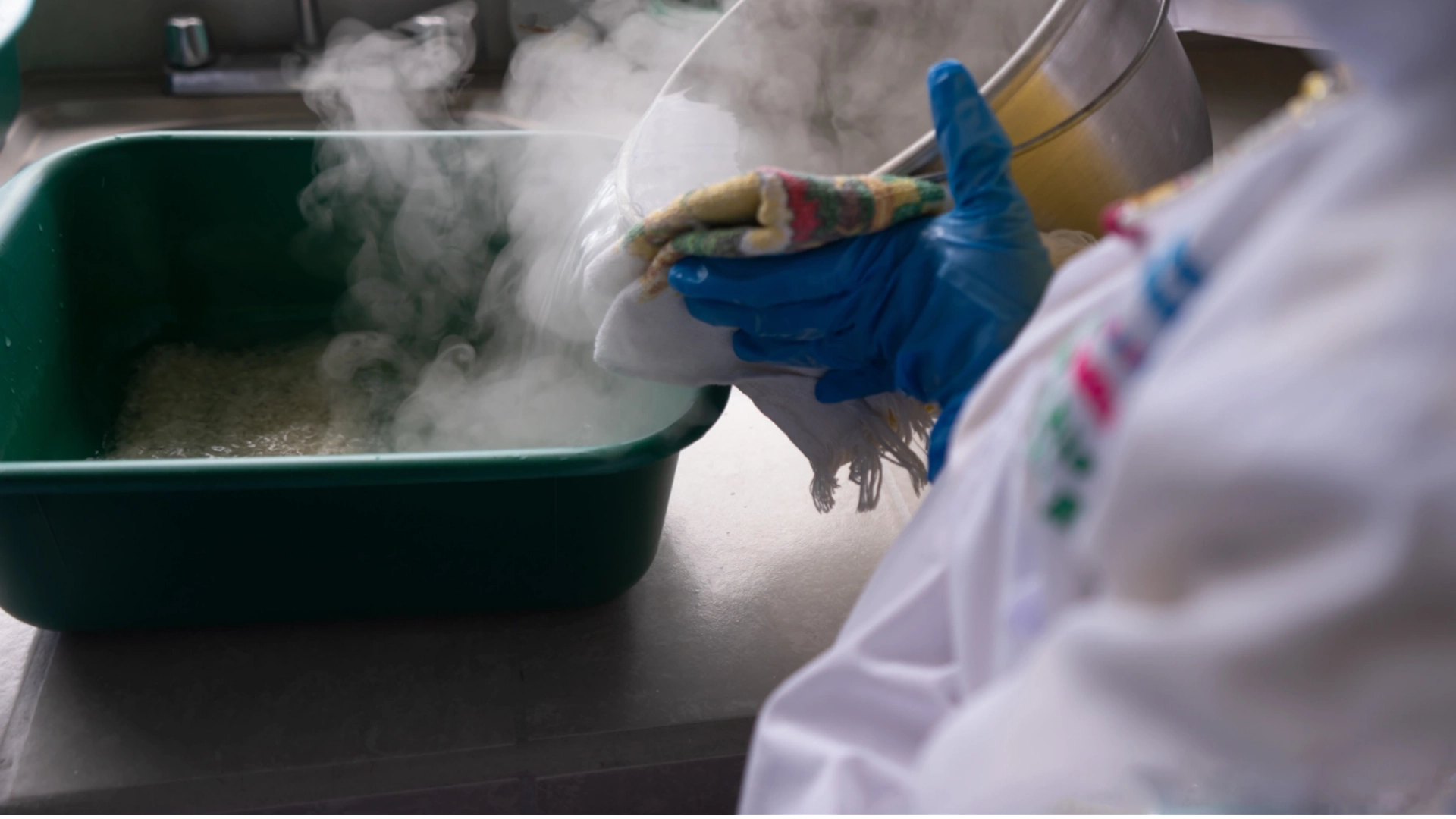
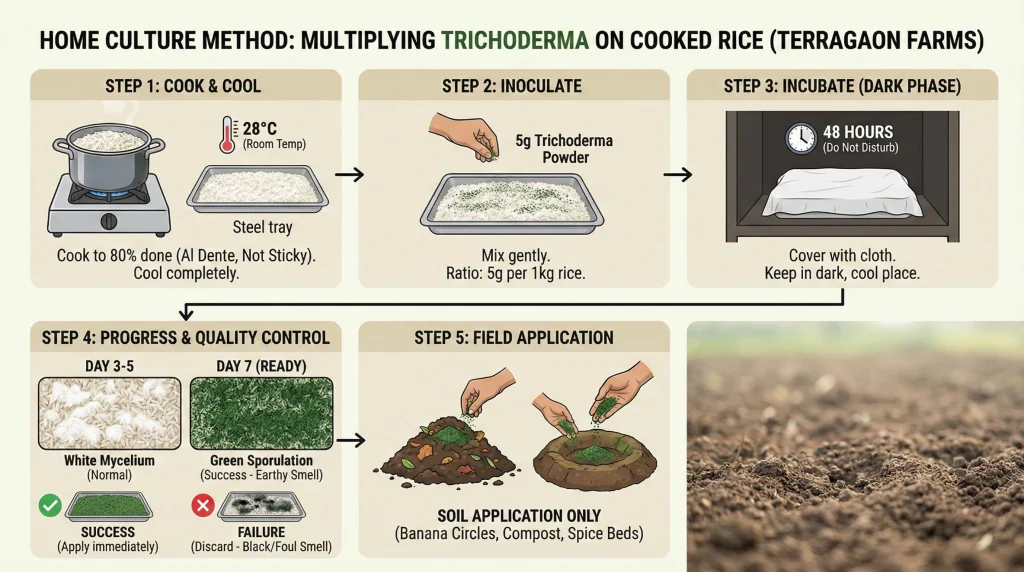
Rice must be cooked only to about eighty percent doneness. The grain should remain firm. Sticky or mushy rice creates anaerobic pockets where bacteria and harmful fungi multiply.
After cooking, the rice is spread thinly on a clean tray and allowed to cool completely to room temperature. Warm rice kills spores instantly.
Inoculation
The working ratio is approximately 5 grams of Trichoderma powder per 1 kilogram of cooked rice.
The powder is sprinkled evenly like salt and mixed gently so each grain is coated. Grains must not be crushed or compacted.
Incubation Phase
The rice is kept loosely spread in the container and covered with a cotton cloth secured against insects. It is placed in a shaded indoor area with stable temperatures around 28–32°C.
The culture is not disturbed for the first forty-eight hours.
Visual Development Timeline
| Day | Expected Observation |
|---|---|
| 2–3 | White cottony mycelium begins spreading |
| 4–5 | Dense fungal network visible |
| 6–7 | Green sporulation develops |
| 8–9 | Culture reaches peak activity |
Green colour is the confirmation signal. Any black, grey, slimy, or foul-smelling growth indicates failure and requires immediate disposal.
The Failure Log: May 2024
During pre-monsoon preparation, trays were placed near a window to “improve airflow”. Morning sunlight raised surface temperature rapidly, causing condensation inside the container. Water droplets formed, and within twenty-four hours black mould (Aspergillus niger) dominated more than half the tray.
The correction was definitive. Cultures must remain in stable shade. Condensation is the primary trigger for contamination in hot climates.
Quality Control: The Nose and Colour Test
Before field use, every batch is graded.
| Indicator | Interpretation | Action |
|---|---|---|
| Deep green, earthy smell | Active Trichoderma | Use immediately |
| White only, no green | Immature culture | Wait 24 hours |
| Black, grey, yellow patches | Toxic contamination | Discard and bury |
| Sour or rotten smell | Bacterial takeover | Discard |
If in doubt, discard. Biological shortcuts are expensive mistakes.
Drying and Storage Reality
The culture can be air-dried in shade for one day to reduce surface moisture. It is stored only in cloth or paper.
| Storage Time (Summer) | Viability |
|---|---|
| 0–15 days | High |
| 16–25 days | Rapid decline |
| Beyond 30 days | Unreliable |
This is living biology. It does not behave like packaged fertiliser.
Economic Impact Per Batch
| Input | Cost (INR) |
|---|---|
| Rice (1 kg) | ₹30 |
| Trichoderma powder (5 g) | ₹5 |
| Labour and fuel | ₹15 |
| Total cost | ₹50 |
This produces approximately 2 kilograms of live culture, equivalent to about ₹400 worth of commercial talc-based product, assuming viability. The savings are substantial, but only if the culture is used quickly and correctly.
Field Application Guide
This culture is strictly for soil use.
In Banana Circles, one handful is mixed into moist mulch on the outer berm.
For ginger and turmeric, it is mixed with vermicompost and applied during earthing up.
For compost activation, one kilogram of culture is mixed into 200 litres of water and drenched into a fresh pile to accelerate decomposition.
It is never applied to dry soil and never sprayed on foliage.
Safety and Ground Reality Note
Home-cultured Trichoderma is biologically effective but not strain-pure. That is acceptable for field soil ecology. It must never be sold, labelled, or stored as certified input.
Growing biology requires humility. Neglect produces poison faster than it produces benefit.
Conclusion
Commercial Trichoderma often reaches rural shelves heat-damaged and biologically dead. By learning controlled home multiplication, the farmer regains biological sovereignty. Inputs become processes. Purchases become skills.
But the responsibility is real. Trichoderma rewards discipline and punishes carelessness. Respect moisture, temperature, and time, and it will serve the soil. Ignore them, and you will culture toxicity.
Frequently Asked Questions (FAQs)
Can Trichoderma be multiplied at home
Yes, using cooked rice under controlled moisture and aeration for soil use.
How long does home-cultured Trichoderma last
About 15–20 days in summer conditions.
Can it replace commercial Trichoderma
For on-farm soil and compost use, yes. Not for resale.
Why does black mould appear
Because of excess moisture, heat fluctuation, or poor hygiene.
Can it be applied to dry soil
No. Always apply under mulch or in moist soil.
Next Step
Field Action: Go to your kitchen. Set aside 2 cups of rice today. Buy a fresh packet of Trichoderma. Start your first “Test Batch” in a small tiffin box to master the moisture level before scaling up.

Krittika Das is a field practitioner and primary author at Terragaon Farms in Birbhum, West Bengal. Her writing is grounded in daily farm work, long-term soil observation, and small-land realities of eastern India. She focuses on natural farming, soil ecology, ethical dairy, and low-input systems, translating field experience into clear, practical knowledge for farmers and conscious food consumers.