

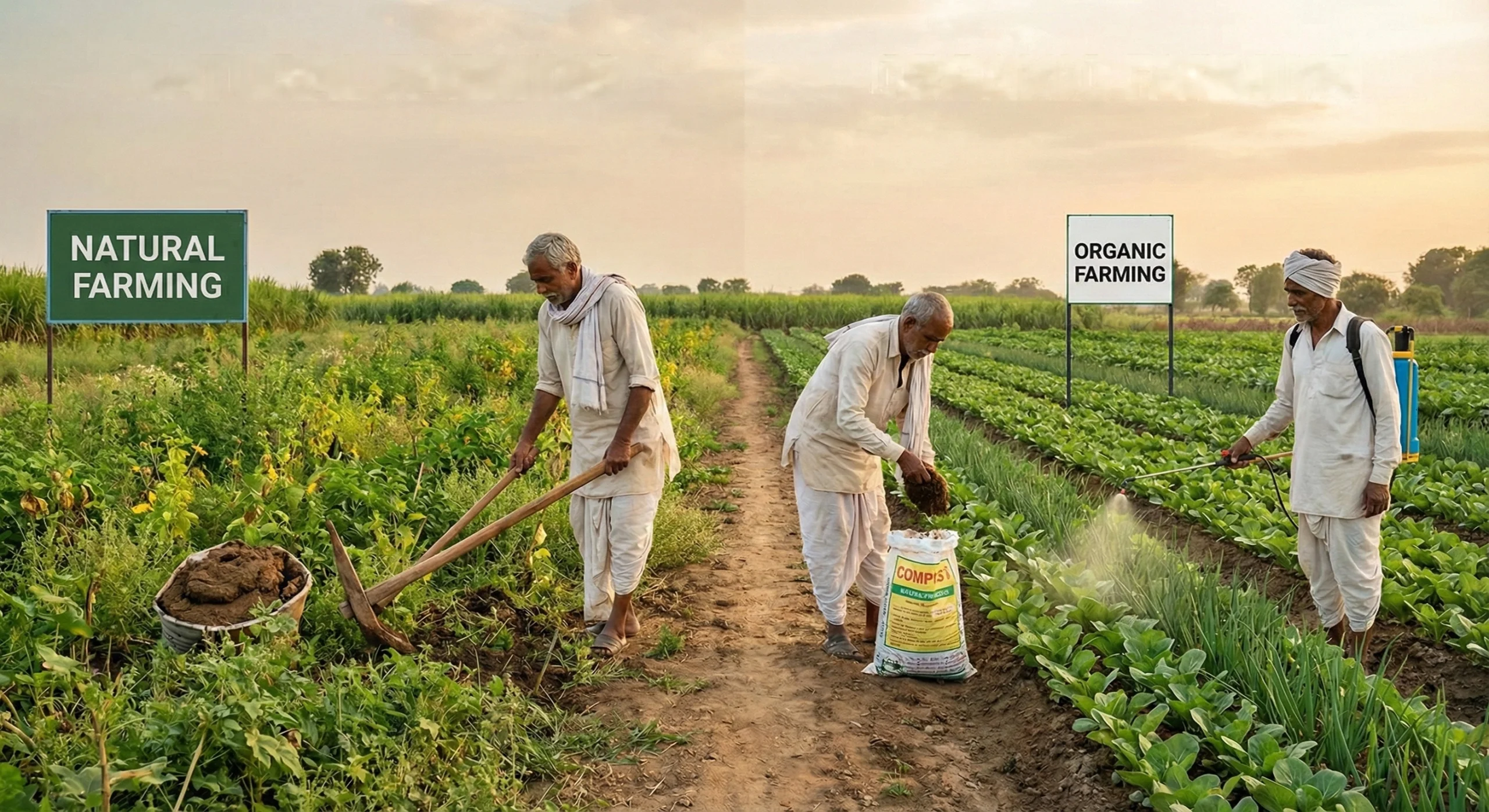
In India, natural farming and organic farming are often spoken about as if they are the same thing. For small farmers, this confusion is not academic. It affects costs, risk, and whether farming remains viable beyond a few seasons.
At Terragaon Farms in Birbhum, West Bengal, we have practiced and observed both approaches closely. The difference became clear not in theory, but in daily decisions about inputs, labor, soil response, and cash flow.
This article explains the real differences between natural farming and organic farming in India, especially from the perspective of small and marginal farmers working under real constraints.
What organic farming means in the Indian context
Organic farming in India is primarily defined by what it avoids. Synthetic fertilisers, synthetic pesticides, and genetically modified seeds are excluded.
In practice, organic farming often replaces chemical inputs with purchased organic inputs such as compost, vermicompost, bio fertilizers, organic pesticides, and certified seeds. Certification standards focus on traceability and input compliance rather than system design.
Organic farming can work well where land size, capital, and market access support it. However, for small farms, the cost structure often remains high because dependency on external inputs continues.
What natural farming means in the Indian context
Natural farming focuses less on substitution and more on elimination.
The objective is to remove dependency on both chemical and purchased organic inputs by rebuilding soil biology and ecological balance. Inputs are prepared on the farm using local resources wherever possible.
Natural farming prioritizes soil life, organic cover, reduced disturbance, crop diversity, and closed loop systems where waste becomes input. Certification is not the focus. Functionality is.
For small farms, this difference shapes sustainability more than ideology.
The core difference small farmers feel first
The most immediate difference between natural farming and organic farming is cost behavior.
Organic farming often lowers chemical expenses but introduces new costs through purchased organic inputs. Natural farming reduces both chemical and organic input dependency over time.
On small land, recurring purchases create financial pressure regardless of input type. Natural farming addresses this by targeting recurring costs rather than input labels.
Soil biology versus input compliance
Organic farming standards ensure approved inputs are used. They do not necessarily guarantee soil biological recovery.
Natural farming places soil biology at the center. Practices are judged by their effect on microbial life, soil structure, and moisture retention rather than compliance checklists.
Healthy soil does not require constant feeding. It requires protection, organic matter, and time.
This distinction becomes visible when crops show resilience under stress rather than dependence on intervention.
Yield expectations and transition stress
Organic farming often promises yield recovery after chemical withdrawal through organic substitutes.
Natural farming accepts that soil recovery takes time and that yield stabilization follows cost reduction, not the other way around.
For small farmers, this honesty reduces stress. Systems are designed for survival first, improvement next.
Labor and management differences
Organic farming often increases labor due to compost application, spraying schedules, and certification requirements.
Natural farming simplifies routines over time. Mulching reduces weeding. Soil health reduces pest emergencies. Observation replaces frequent intervention.
For family managed farms, predictability matters more than theoretical efficiency.
Market dependence and certification realities
Organic farming often depends on certification to access premium markets. Certification costs, audits, and paperwork can be challenging for small farmers.
Natural farming relies more on local trust, transparency, and direct relationships. While premium pricing may exist, the system does not depend on it to remain viable.
For many small farms, reduced cost is more reliable than higher price.
Risk exposure under Indian conditions
Indian farming faces climate variability, market fluctuation, and labor uncertainty.
Organic farming reduces chemical risk but often retains financial risk through input dependency. Natural farming reduces both financial and ecological risk by simplifying systems.
This is why natural farming often performs better under stress conditions such as drought, delayed monsoon, or labor shortage.
What each system does well
Organic farming works well for farmers with access to capital, certification support, and premium markets.
Natural farming works well for farmers prioritizing low cost, resilience, and long term soil health under small land constraints.
Neither system is universal. Context decides suitability.
Common misconceptions
Natural farming is not anti science. It aligns closely with soil biology and agroecology.
Organic farming is not automatically low cost. Input substitution can be expensive.
Both systems fail when adopted blindly without understanding local conditions.
Final thoughts
Natural farming vs organic farming in India is not a debate about purity. It is a decision about dependency.
At Terragaon Farms, natural farming proved sustainable because it reduced the number of things we had to buy, manage, and worry about. Soil health improved, costs stabilized, and farming became predictable again.
For small farms in India, the better system is often the one that removes pressure rather than adds labels.