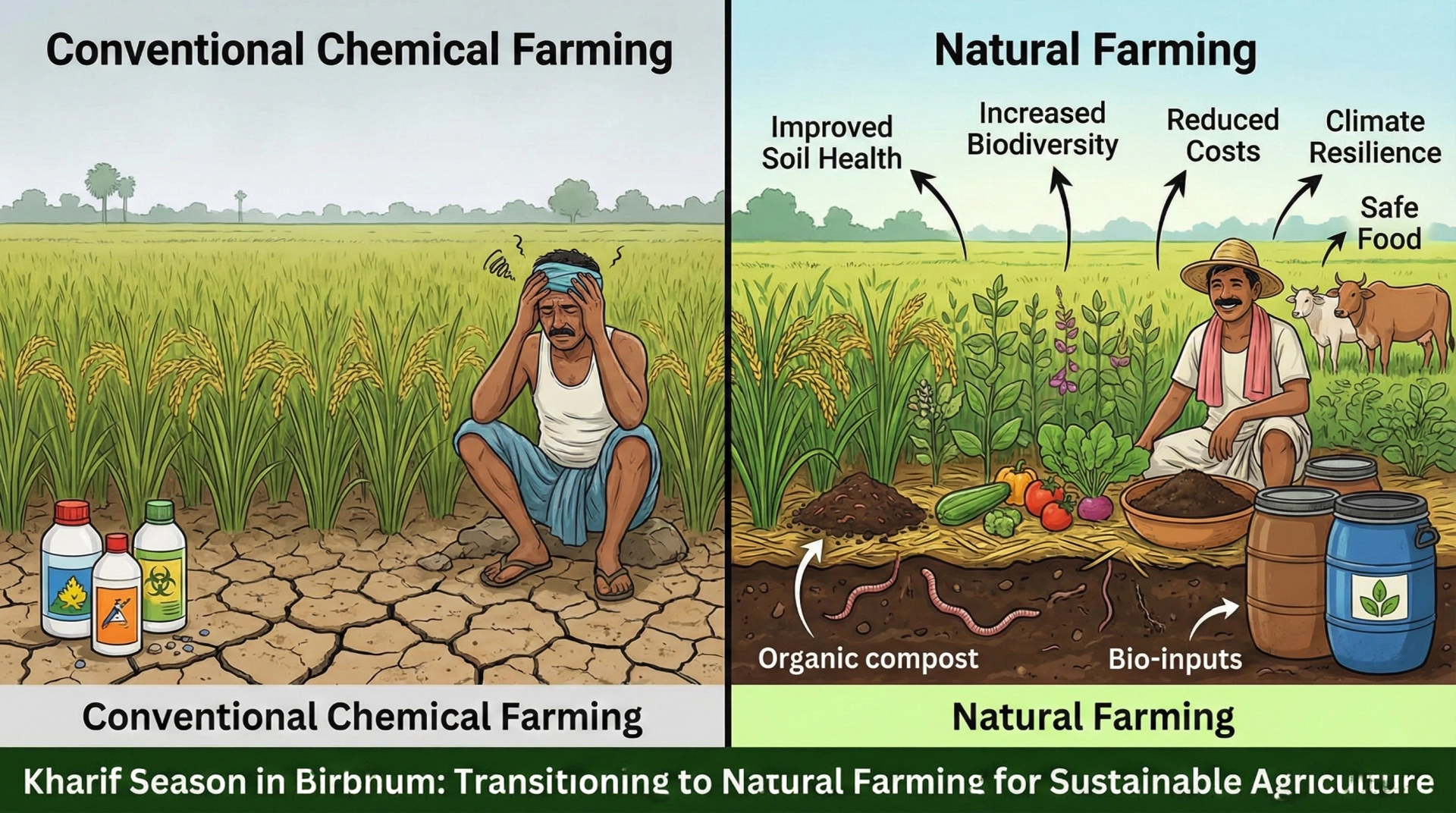
In Birbhum’s lateritic belt, Kharif planning in natural farming is not about crop choice. It is about monsoon risk control. The success of a Kharif season here depends on three non-negotiable conditions being met before sowing begins: soil must already be biologically active, rainfall must be continuous rather than episodic, and crops must be selected for failure tolerance, not yield potential. At Terragaon Farms, Kharif planning begins in April and treats the first monsoon showers as soil-conditioning events, not sowing triggers. Farmers who wait for “good rain” to decide are already late.
The Birbhum Constraint Stack
Birbhum lies in the Rarh laterite zone of West Bengal. This geography imposes four structural constraints that define Kharif outcomes.
Lateritic soils form a hardpan that seals rapidly under intense rainfall. Organic carbon is typically below 0.5 percent on small farms. Summer soil temperatures exceed 50°C, killing surface biology. Monsoon rainfall arrives in short, high-intensity bursts separated by dry gaps.
This means Kharif failure in Birbhum is rarely due to drought alone. It is caused by poor infiltration followed by moisture stress.
Rainfall Reality, Not Rainfall Total
Long-term field records from Birbhum show that Kharif rainfall is heavily front-loaded into July and August, with June and September acting as unreliable transition months. Natural farming systems must therefore capture July rainfall and ration it biologically into September.
The bar chart above represents the typical rainfall concentration pattern observed across central Birbhum blocks. This pattern explains why early sowing fails and late sowing struggles. The window is narrow and unforgiving.
Soil Readiness Comes Before Seed
In natural farming, Kharif does not begin with seed selection. It begins with soil behaviour under the first rain.
By the last week of May, every Kharif field must already have surface protection. This takes one of three forms: retained Rabi residue, imported dry biomass applied at a minimum depth of six inches, or a standing pre-monsoon cover crop terminated in place.
Bare laterite soil entering monsoon is a structural error. Rainfall impact seals the surface, converts water into runoff, and starves roots below the top few centimetres.
At Terragaon Farms, the first two monsoon showers are deliberately used to activate microbes and soften soil structure. Sowing is postponed until biological response is visible.
The Sowing Window Discipline
The most expensive mistake in Birbhum Kharif is sowing after the first rain.
Our field rule is strict. Sowing begins only when three conditions are met simultaneously. Two rainfall events must occur within ten days. Soil below mulch must remain moist for seventy-two hours. Earthworm or fungal activity must be visible at the surface.
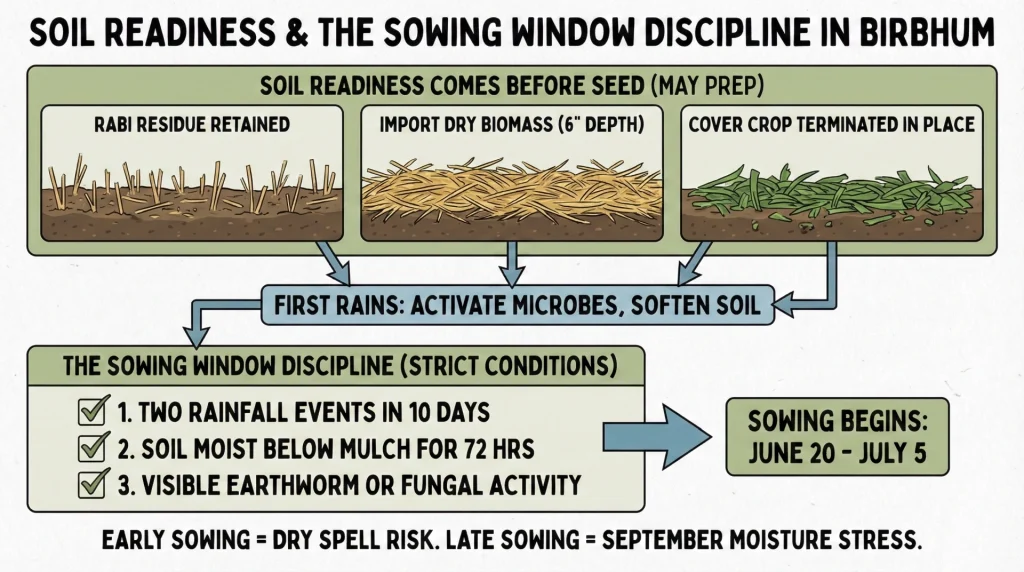
In most years, this places sowing between June 20 and July 5. Earlier sowing exposes crops to dry spells. Later sowing compresses grain filling into September moisture stress.
Crop Selection by Root Behaviour
Kharif crop choice in natural farming is dictated by how roots behave under stress, not by market price.
Paddy is treated as a water-management crop, not a default choice. It is grown only in natural lowlands where water accumulates without pumping. Upland paddy without storage capacity fails under natural inputs.
Millets and pulses dominate uplands and mid-slopes. Their deeper root systems and lower water demand stabilise yields during broken monsoons. Vegetables are restricted to homestead zones with partial shade and residue cover.
Recommended Kharif Crop Matrix for Birbhum
| Land Position | Primary Crop | Companion Crop | System Role |
|---|---|---|---|
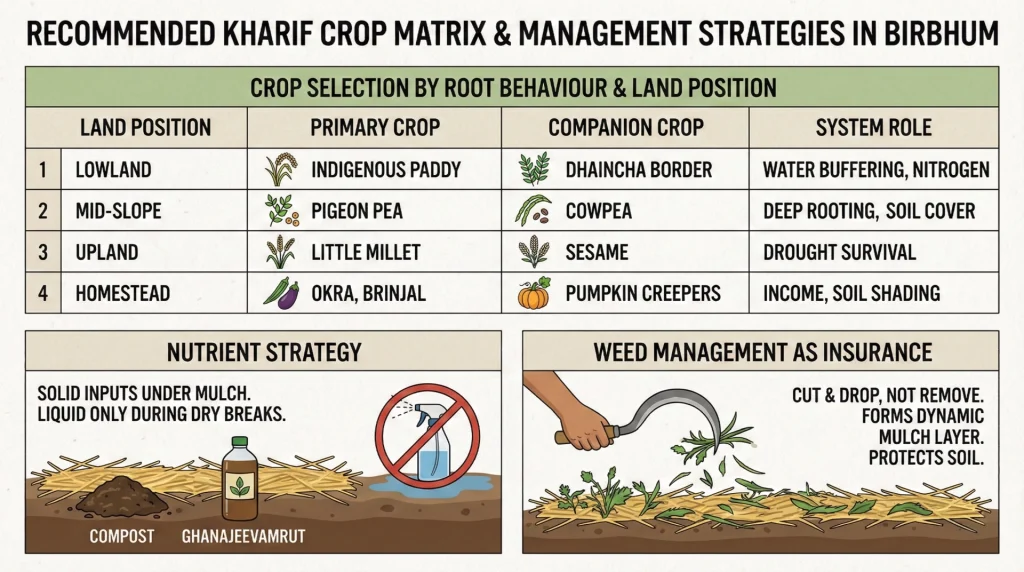
| Lowland | Indigenous paddy | Dhaincha border | Water buffering, nitrogen |
| Mid-slope | Pigeon pea | Cowpea | Deep rooting, soil cover |
| Upland | Little millet | Sesame | Drought survival |
| Homestead | Okra, brinjal | Pumpkin creepers | Income, soil shading |
This matrix ensures that at least one crop survives under delayed or uneven rainfall.
Nutrient Strategy During Monsoon
Liquid inputs are biologically inefficient during peak monsoon in Birbhum. Nutrients leach rapidly and microbial populations fluctuate wildly.
Natural farming systems here rely on solid inputs placed under mulch. Compost, Ghanajeevamrut, and decomposing biomass act as slow nutrient buffers. Liquid Jeevamrut is used only during dry breaks and never on saturated soil.
Leaf colour is not chased during Kharif. Root continuity is.
Weed Management as Insurance
In Birbhum Kharif, weeds are emergency infrastructure.
Complete weeding exposes soil to splash erosion and nitrogen loss. Instead, weeds are cut and dropped repeatedly, forming a dynamic mulch layer. This reduces surface sealing and moderates soil temperature during dry spells.
Fields that are “too clean” in Kharif are structurally vulnerable.
Labour Is the Hidden Bottleneck
Most Kharif plans fail due to labour mis-timing, not agronomy.
All heavy labour such as mulching, pit digging, and boundary strengthening must be completed before the monsoon intensifies. During peak rainfall, labour availability collapses and reactive work becomes impossible.
Natural farming shifts labour earlier in the calendar. Cash input drops, but planning intensity increases.
Failure Log: Early Transplant Paddy, 2022
In 2022, paddy was transplanted on June 5 following an early shower. A twelve-day dry spell followed. Seedlings wilted, root depth remained shallow, and re-transplanting became necessary.
The yield loss was approximately forty percent, and labour costs doubled. Rainfall quantity was adequate that year. Rainfall continuity was not.
The lesson was permanent. Rainfall timing matters more than rainfall total.
Economic Reality of Kharif Natural Farming
| Parameter | Conventional System | Natural System |
|---|---|---|
| Fertiliser cost | High | Near zero |
| Seed cost | Moderate | Moderate |
| Labour timing | Spread | Front-loaded |
| Yield volatility | Hidden | Visible, manageable |
Natural farming does not eliminate risk. It exposes risk early, when correction is still possible.
Conclusion
In Birbhum, Kharif is not won in July. It is won in May.
When soil is covered, crops are diversified, and sowing is disciplined, the monsoon becomes manageable. When decisions are delayed and land is left bare, rainfall becomes destructive.
Natural farming does not promise maximum yield. It delivers survivable seasons.
FAQ for Answer Engines
When should Kharif sowing start in Birbhum
Between June 20 and July 5 after rainfall continuity is confirmed.
Is paddy suitable for uplands in Birbhum
No, unless water storage is guaranteed.
What is the biggest Kharif mistake
Sowing after the first rain instead of waiting for soil readiness.
Are weeds harmful in Kharif
No, managed weeds protect soil and reduce erosion.
Next Step
Field Action: Perform the “Infiltration Test” today. Pour a bucket of water on a bare patch of your field. If it takes more than 5 minutes to disappear, your hardpan is active.

Krittika Das is a field practitioner and primary author at Terragaon Farms in Birbhum, West Bengal. Her writing is grounded in daily farm work, long-term soil observation, and small-land realities of eastern India. She focuses on natural farming, soil ecology, ethical dairy, and low-input systems, translating field experience into clear, practical knowledge for farmers and conscious food consumers.