On most farms, livestock are treated as production units. Milk, meat, eggs. Waste is something to manage, remove, or neutralize. At Terragaon Farms, we learned early that this separation weakens both soil and animals. When livestock are disconnected from soil, fertility declines and dependency rises.
At Terragaon Farms, livestock are not an add-on. They are the living link that keeps soil, crops, and farming systems alive. Indigenous cows, goats, and poultry form the heart of our nutrient cycle. Their presence allows the farm to regenerate fertility continuously without chemical dependence.
In short:
The livestock and soil nutrition cycle is a closed-loop system where animal waste becomes organic matter, organic matter feeds soil life, and healthy soil nourishes crops that feed animals again.
What the livestock and soil nutrition cycle really means
The livestock and soil nutrition cycle describes how nutrients move through a farm when animals and crops are integrated.
Animals consume fodder grown on the farm. Their dung and urine return to the land as compost, liquid biofertilizers, and soil amendments. Soil microbes break this organic matter down into plant-available nutrients. Crops grow stronger. Residues return as fodder or mulch. The cycle continues.
When this loop remains intact, fertility is renewed naturally instead of being purchased from outside.
Why animals are essential for soil health
Soil is a living system. It depends on organic inputs to sustain microbial activity.
Animal manure provides more than nutrients. It delivers carbon, microbes, enzymes, and moisture that activate soil life. This biological activity improves aggregation, water infiltration, and nutrient cycling.
Without regular organic inputs, soil becomes compacted, less responsive, and increasingly dependent on synthetic fertilisers.
Livestock restore what continuous cropping removes.
The role of indigenous cows in nutrient cycling
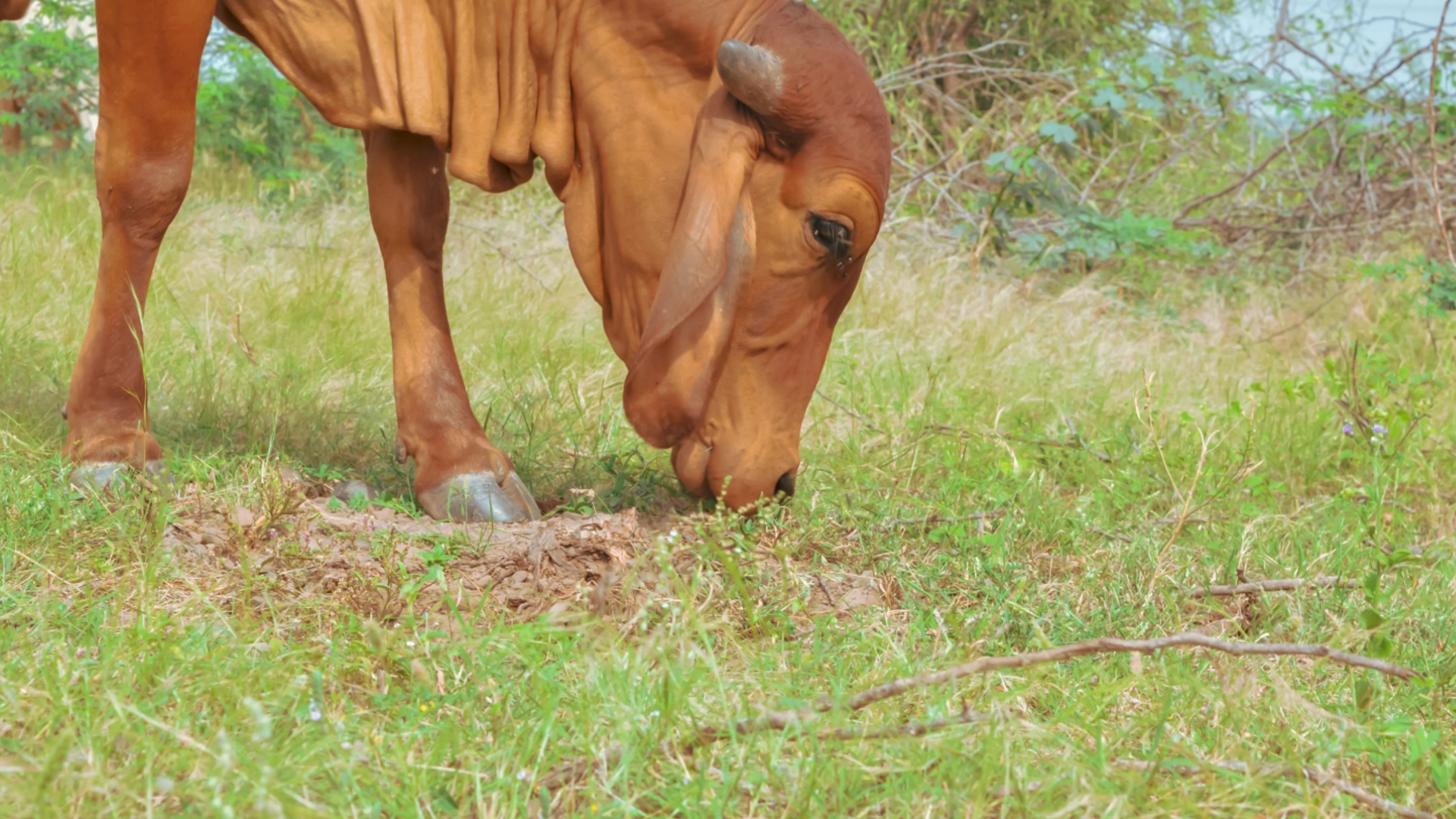
Indigenous cows play a central role in Terragaon’s nutrient cycle.
Their dung and urine are rich in diverse microorganisms adapted to local conditions. These inputs are used to prepare compost, liquid microbial cultures, and soil conditioners that feed soil life rather than plants directly.
This biological feeding strengthens root systems, improves nutrient uptake, and reduces disease pressure over time.
Indigenous cows fit this cycle well because their feed requirements align with what small farms can realistically grow.
Goats and poultry as complementary contributors
Goats and poultry add flexibility to the nutrient cycle.
Goats convert grasses, weeds, and tree leaves into manure that enriches compost piles. Poultry scratch soil surfaces, reduce insect pressure, and produce nutrient-dense droppings that accelerate composting.
Each species contributes differently. Together, they increase nutrient diversity and system resilience.
Diversity in livestock mirrors diversity in soil biology.
From waste to organic matter
In an integrated system, waste does not exist.
Dung is composted or applied through controlled methods. Urine is diluted and used as microbial stimulant. Bedding material becomes carbon-rich compost input. Poultry litter enriches soil when handled carefully.
This transformation reduces dependency on external fertilisers and prevents nutrient loss through runoff or volatilisation.
Fertility stays where it belongs, in the soil.
How this cycle improves soil structure and water retention
Organic matter from livestock improves soil structure gradually.
Soil aggregates become stable. Pore spaces form naturally. Water infiltrates instead of running off. Roots penetrate deeper. Crops withstand dry periods better.
These physical improvements reduce irrigation needs and protect crops during climate stress.
Soil health improvement is slow, but its effects compound over years.
Reducing chemical dependence through biology
When soil biology is active, nutrient availability becomes more efficient.
Plants access nutrients through microbial processes instead of chemical salts. Pest pressure reduces as plant health improves. Disease resistance strengthens.
Chemical dependence falls not because inputs are banned, but because they are no longer necessary.
This transition protects soil, reduces cost volatility, and stabilises farm economics.
Labour and cost benefits of closed-loop systems
Closed-loop nutrient systems reduce daily intervention.
Instead of frequent fertiliser application, fertility builds steadily. Composting becomes routine rather than emergency response. Veterinary costs often reduce as animal health stabilises.
Labour becomes predictable. Expenses become manageable. Stress reduces.
These human benefits are as important as soil improvement.
Why nutrient cycles fail when livestock are isolated
When livestock are separated from crops, manure becomes waste and crops depend on purchased inputs.
Costs rise. Soil health declines. Systems fragment. Each enterprise competes for resources.
This separation breaks the cycle and increases vulnerability.
Integration restores balance.
Final thoughts
Livestock nourish the earth when they are allowed to function within a living system.
At Terragaon Farms, indigenous cows, goats, and poultry are not valued only for what they produce directly. They are valued for how they keep soil alive, fertility cycling, and farming resilient.
When animals, soil, and crops support each other, farming becomes regenerative rather than extractive. This is not an idealistic vision. It is a practical system that works year-round on small land.
Animals that nourish the earth do more than sustain crops. They sustain the future of farming.