Many farmers treat Kharif and Rabi as fixed calendars. Inputs change, crops change, but planning remains reactive. In natural farming, seasons are not just time periods. They are biological phases that determine soil recovery, moisture balance, pest behavior, and labor pressure.
At Terragaon Farms in Birbhum, West Bengal, natural farming began to work only when we stopped planning crops first and started planning seasons first. Once soil, water, and labor were aligned with Kharif and Rabi realities, cropping decisions became clearer and mistakes reduced.
This article explains how seasonal planning actually works in natural farming for Kharif and Rabi under Indian small farm conditions.
Why seasonal planning matters more in natural farming
Natural farming depends on biological processes rather than quick chemical correction.
Microbial activity, organic matter breakdown, root growth, and pest cycles all respond strongly to temperature, moisture, and daylight. These factors shift dramatically between Kharif and Rabi.
Without seasonal planning, farmers often apply the same logic year round. This leads to wasted effort in one season and missed opportunity in another.
Seasonal planning allows natural systems to work with conditions instead of fighting them.
Understanding Kharif season in natural farming
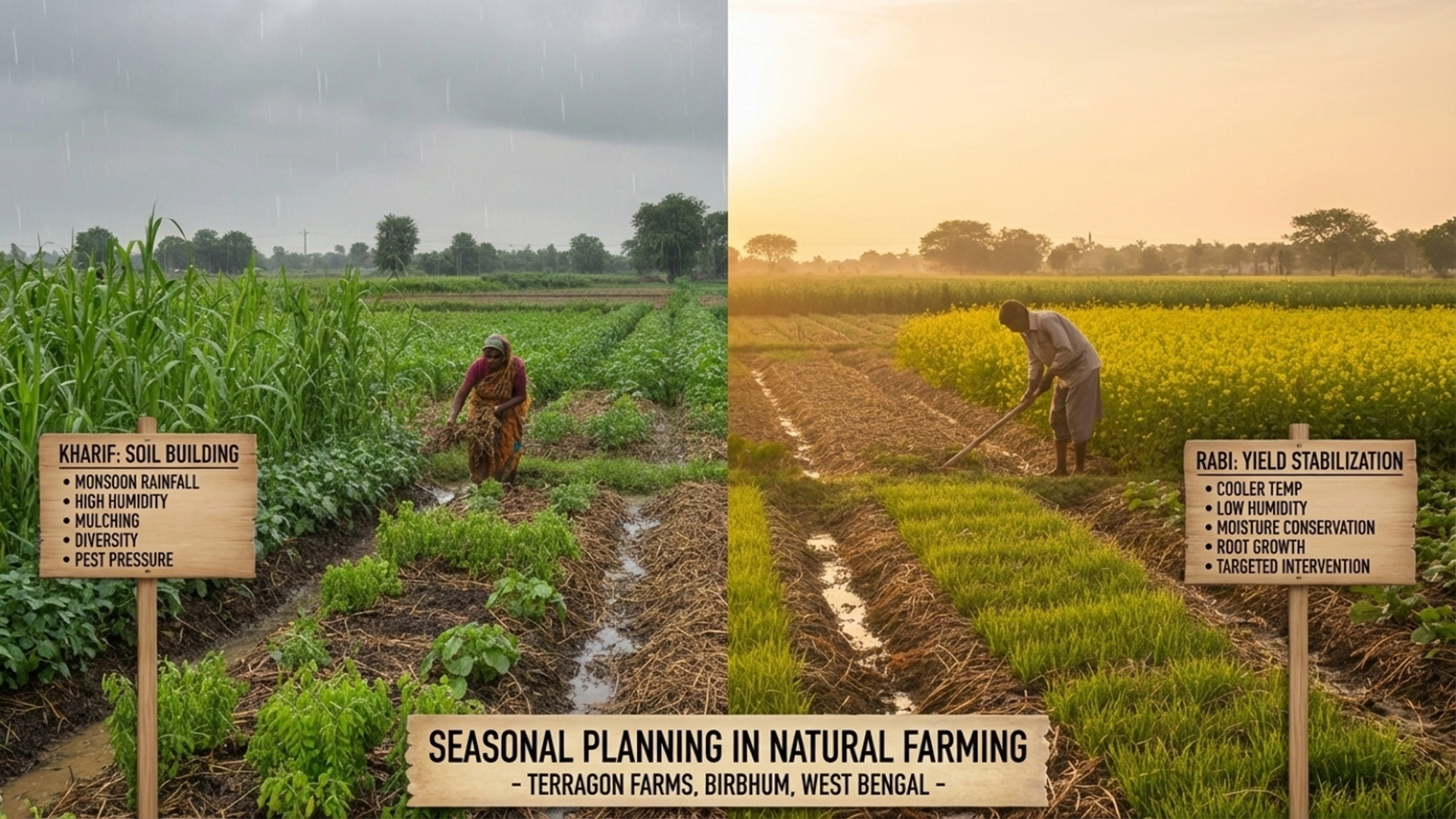
Kharif season is defined by monsoon rainfall, high humidity, and warm temperatures.
These conditions are ideal for microbial activity and organic matter decomposition. They are also favorable for weeds, pests, and fungal diseases if balance is disturbed.
In natural farming, Kharif is primarily a soil building and system stabilizing season.
Soil focus during Kharif
During Kharif, protecting soil is critical.
Heavy rainfall can either recharge soil or wash it away. Mulching reduces runoff, prevents surface sealing, and feeds microbes actively during warm conditions.
Reduced tillage becomes especially important. Frequent disturbance during wet conditions damages soil structure quickly.
Kharif is the best season to rebuild organic matter if soil is kept covered.
Crop planning for Kharif
Natural farming favors crops that tolerate moisture variation and support soil biology.
Millets, pulses, oilseeds, paddy under low disturbance systems, and mixed cropping combinations perform well. Legumes support nitrogen cycling naturally.
High dependency crops during Kharif often increase pest pressure and disease risk under natural systems.
Diversity matters more than density in this season.
Pest and disease behavior in Kharif
Pest pressure often increases in Kharif due to humidity.
Natural farming manages this through crop diversity, air circulation, and plant health rather than frequent spraying. Botanical interventions are used only when observation indicates imbalance.
Routine spraying often worsens fungal issues during humid conditions.
Understanding Rabi season in natural farming
Rabi season is defined by cooler temperatures, lower humidity, and controlled moisture.
Microbial activity slows compared to Kharif, but soil structure and root development improve if moisture is managed well.
In natural farming, Rabi is a crop consolidation and yield stabilization season.
Soil focus during Rabi
Soil moisture conservation becomes critical.
Mulching from Kharif residues plays a major role in retaining moisture. Over irrigation during Rabi damages roots and soil biology.
Minimal disturbance protects structure built during monsoon.
Rabi rewards patience and restraint.
Crop planning for Rabi
Rabi crops benefit from steady moisture and healthy root zones.
Wheat, mustard, pulses, vegetables, and fodder crops perform well when soil has been protected during Kharif.
Natural farming in Rabi relies heavily on what was done earlier. Soil neglected in Kharif rarely performs well in Rabi without high intervention.
Rabi success is earned during monsoon.
Pest behavior in Rabi
Pest pressure often reduces in cooler months.
Healthy plants show better tolerance. Interventions are fewer and more targeted.
This makes Rabi easier to manage for beginners once systems are stabilized.
Labor planning across seasons
Seasonal planning is also labor planning.
Kharif demands more attention due to weeds, rainfall management, and crop diversity. Rabi is more predictable but sensitive to moisture timing.
Natural farming works best when labor peaks are anticipated and systems are simplified accordingly.
Overloading families during Kharif often leads to burnout before Rabi benefits appear.
Common seasonal planning mistakes
Treating Kharif and Rabi identically leads to poor results. Ignoring soil cover during monsoon causes long term damage. Expecting Rabi crops to compensate for neglected Kharif planning creates frustration.
Natural farming requires seasonal discipline, not seasonal improvisation.
How seasonal planning improves stability
When Kharif is used to build soil and Rabi is used to harvest stability, natural farming becomes predictable.
Costs reduce. Pest pressure stabilizes. Yield variability declines.
Seasonal alignment turns natural farming from an experiment into a system.
Final thoughts
Seasonal planning in natural farming is not about rigid calendars. It is about understanding how soil, water, plants, and labor behave differently in Kharif and Rabi.
At Terragaon Farms, natural farming became manageable only when seasonal roles were respected. Monsoon built the system. Winter harvested its benefits.
For small farmers in India, seasonal planning is not optional. It is the foundation that allows natural farming to work year after year.

Krittika Das is a field practitioner and primary author at Terragaon Farms in Birbhum, West Bengal. Her writing is grounded in daily farm work, long-term soil observation, and small-land realities of eastern India. She focuses on natural farming, soil ecology, ethical dairy, and low-input systems, translating field experience into clear, practical knowledge for farmers and conscious food consumers.