After the same rainfall, some fields stay moist for days while others dry out within hours. Farmers notice this difference clearly, especially during dry spells. One field needs irrigation again. Another holds moisture quietly and supports crops longer. This difference is not luck. It is soil structure and biology at work.
At Terragaon Farms in Birbhum, West Bengal, we observed that moisture retention improved long before yields increased. Soil began behaving differently. Water entered slowly, stayed longer, and supported roots deeper into the season. Understanding why some fields retain moisture better requires looking beyond irrigation schedules and into porosity, organic matter, roots, and microbial activity.
Moisture retention is a soil property, not a rainfall issue
Rainfall adds water. Retention decides how long that water remains available to crops.
Soils that drain instantly or lose moisture rapidly are not lacking water input. They are lacking structure. Moisture retention depends on pore size balance, aggregate stability, and biological glue holding particles together.
This is why two fields with identical rainfall show very different moisture behaviour.
Porosity decides how water enters and stays
Healthy soil contains a range of pore sizes.
Large pores allow excess water to drain and air to move. Small pores hold water against gravity so roots can access it later. When this balance exists, soil absorbs water quietly and releases it slowly.
In degraded soils, pores collapse or become uniform. Water either runs off or drains too quickly. Moisture retention fails even when irrigation is frequent.
Porosity is created by roots, microbes, and organic matter, not by fertiliser.
Organic matter acts like a sponge
Organic matter increases moisture retention by holding water within soil aggregates.
Even small increases in organic matter significantly improve water holding capacity, especially in lighter and lateritic soils. Organic matter absorbs water, slows evaporation, and stabilizes pores.
When organic matter declines, soil becomes mineral dominated. Water moves through quickly and leaves soil dry and stressed.
This is why fertilised soils can still suffer from drought stress.
Roots create channels and storage
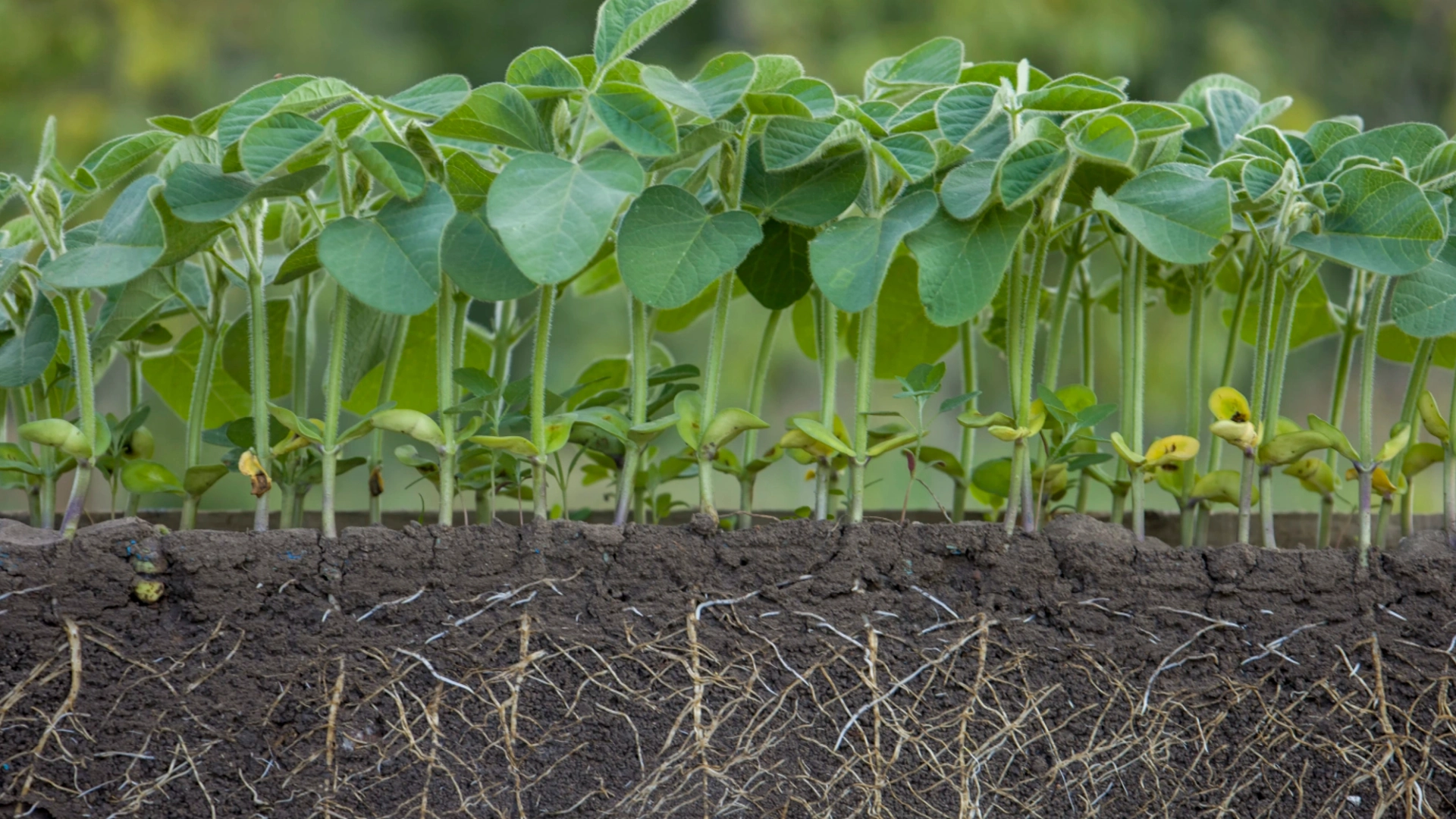
Living roots are one of the most important drivers of moisture retention.
Roots create channels that allow water to penetrate deeper layers. When roots decay, these channels remain as pathways and storage spaces. Different crops create different pore patterns, improving overall structure.
Fields with continuous or diverse root presence retain moisture better than fields left bare between crops.
This effect becomes visible over seasons, not days.
Microbial glue holds soil together
Microbes produce substances that bind soil particles into aggregates.
Fungi weave networks that stabilize structure. Bacteria produce sticky compounds that hold particles together. This biological glue prevents pore collapse and allows soil to hold water without sealing.
When microbes decline due to heat, drying, or disturbance, this glue weakens. Aggregates break. Moisture retention collapses.
This is why soil biology is central to water behaviour.
Why compaction reduces moisture retention
Compaction reduces both infiltration and storage.
Compacted soil blocks water entry and eliminates pore space. Water either runs off or pools briefly before evaporating. Roots cannot penetrate, further reducing porosity.
Even high rainfall cannot compensate for compacted structure.
Reducing traffic and disturbance is essential for restoring moisture retention.
Why some irrigated fields still dry quickly
Irrigation adds water but does not fix structure.
Fields irrigated frequently but left bare often show rapid drying because evaporation is high and pore structure is weak. Without organic matter and cover, added water leaves quickly.
This leads to a cycle of frequent irrigation, higher stress, and declining efficiency.
What improves moisture retention under Indian conditions
Moisture retention improves when soil is protected and biology is allowed to function.
Continuous mulch reduces evaporation and heat stress. Organic residues feed microbes. Reduced disturbance preserves pore structure. Diverse crops create varied root systems.
At Terragaon Farms, soil began holding moisture longer once mulching became continuous and tillage was reduced. Irrigation frequency dropped before yields changed.
This sequence is common and reliable.
How farmers can observe moisture improvement
Improvement shows up first in soil feel and behaviour.
Soil stays moist below the surface longer. Water infiltrates without puddling. Crops remain turgid during short dry spells. Roots explore deeper layers.
These signs appear before any formal measurement.
Common misunderstandings about moisture retention
Many believe clay soil always holds water better. Without structure, even clay dries and cracks quickly.
Others assume compost alone solves moisture issues. Without protection, compost benefits fade.
Some focus only on irrigation schedules while ignoring soil behaviour.
Moisture retention responds to systems, not single actions.
Final thoughts
Some fields stay wet longer because their soil holds water by design, not by chance.
Porosity, organic matter, roots, and microbial glue work together to store moisture and release it slowly. Fertiliser and irrigation cannot replace these processes.
At Terragaon Farms, moisture retention improved when soil was treated as a living structure rather than a container for inputs. Once soil began holding water, crops required less intervention and stress reduced.
For Indian farmers, improving moisture retention is not about adding more water. It is about rebuilding the soil’s ability to keep what it receives.

Krittika Das is a field practitioner and primary author at Terragaon Farms in Birbhum, West Bengal. Her writing is grounded in daily farm work, long-term soil observation, and small-land realities of eastern India. She focuses on natural farming, soil ecology, ethical dairy, and low-input systems, translating field experience into clear, practical knowledge for farmers and conscious food consumers.