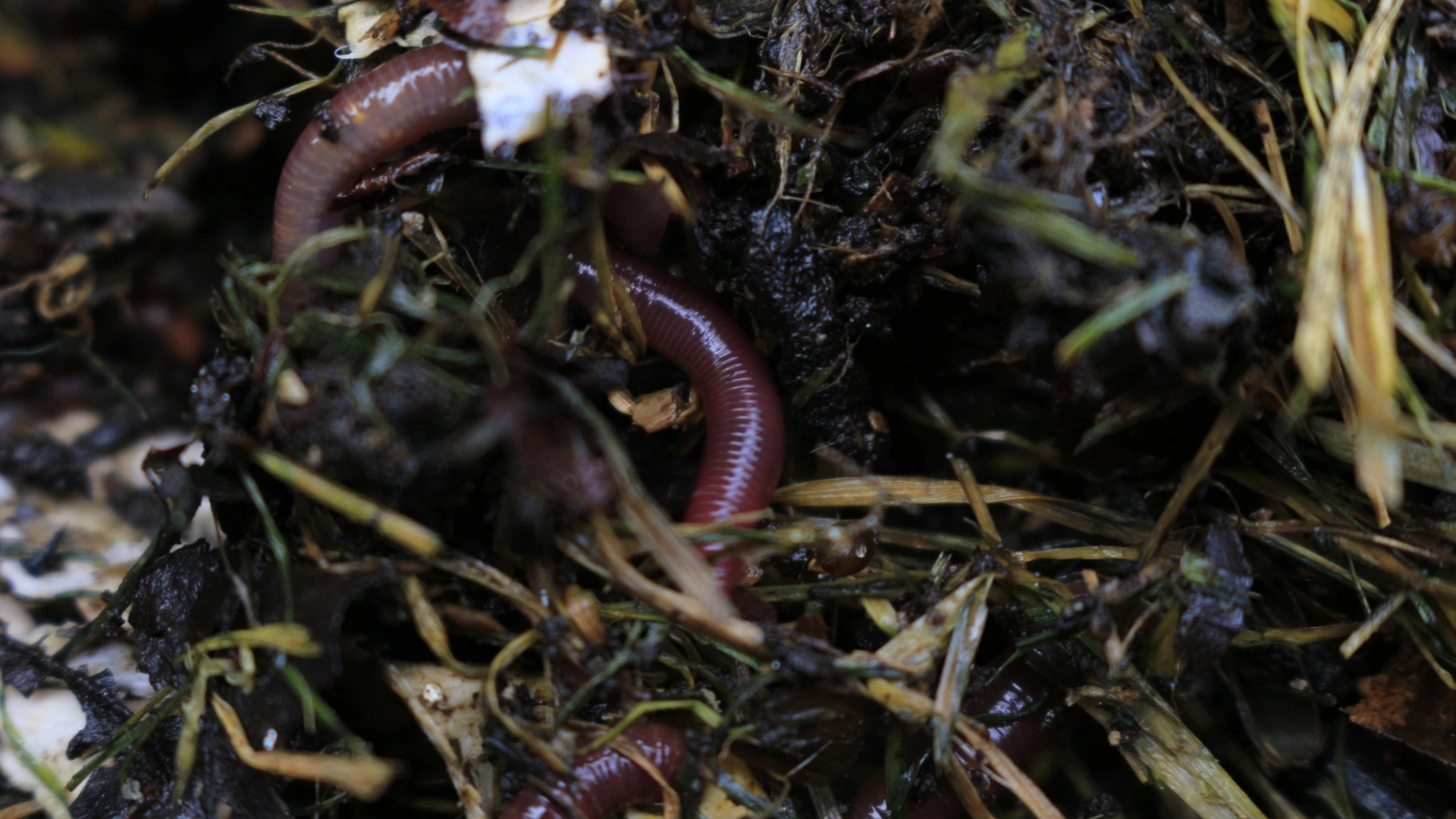
Farmers often say they used to see earthworms everywhere. Today, many cultivated fields show none at all. The usual explanation points to pesticides, but that answer is incomplete. Earthworms disappear mainly when their habitat collapses, not when a single input is applied.
At Terragaon Farms in Birbhum, West Bengal, earthworms returned only after soil conditions changed consistently over seasons. Their absence and return followed clear patterns tied to moisture, organic matter, and disturbance. This article explains why earthworms leave cultivated fields and what actually allows them to come back under Indian conditions.
What earthworms need to survive in farm soil
Earthworms are not indicators of cleanliness or morality. They are indicators of habitat quality.
They need stable moisture, moderate temperature, oxygen pathways, and a steady supply of organic residues. They also need soil that is not repeatedly disturbed. When these conditions exist, earthworms survive even alongside conventional inputs. When these conditions fail, earthworms disappear regardless of intent.
Understanding this shifts the focus from blame to management.
Habitat loss is the primary cause
The biggest reason earthworms disappear is loss of habitat.
Bare soil heats rapidly under Indian sun. Surface layers dry out daily. Pores collapse. Food sources are removed. In such conditions, earthworms either migrate deeper or die.
Fields kept bare between crops lose habitat for months at a time. Over years, populations collapse completely.
This process is slow and silent, which is why farmers often do not notice until worms are already gone.
Moisture instability matters more than rainfall
Earthworms need moisture stability, not just rainfall.
Soils that alternate between waterlogging and complete dryness stress earthworms severely. This happens commonly in irrigated fields without cover, where water is applied heavily and then allowed to dry fully.
Even in high rainfall regions, exposed soil dries rapidly between showers. Earthworms cannot recover fast enough under repeated stress.
Consistent moisture, not frequent irrigation, supports worm survival.
Organic matter removal starves earthworms
Earthworms feed on decaying organic material.
When crop residues are removed, burned, or fed elsewhere year after year, food supply declines. Compost alone rarely compensates because it is applied intermittently and often incorporated deeply.
Mulched residues on the surface provide continuous food and protection. Without them, earthworms starve even if soil receives fertiliser.
This is why fertilised fields can still lack worms.
Disturbance through tillage destroys burrows
Earthworm burrows are long term structures.
Repeated ploughing collapses these tunnels and physically injures worms. Even if some survive, populations cannot stabilize because habitat is destroyed faster than it is rebuilt.
Deep tillage is especially damaging in lighter and lateritic soils where structure is weak.
Reduced disturbance allows burrows to persist and populations to recover gradually.
Pesticides are not the only factor
Certain pesticides can harm earthworms directly, especially when misused. However, earthworm decline occurs even in fields with minimal pesticide use if habitat conditions are poor.
Blaming pesticides alone misses the broader picture. Habitat loss makes worms vulnerable. Chemicals may accelerate decline, but they are rarely the sole cause.
This distinction matters because it directs solutions toward system design rather than single product replacement.
Compaction blocks oxygen and movement
Compacted soil restricts oxygen flow and limits movement.
Earthworms require oxygen and space to burrow. When soil is compacted by machinery, trampling, or repeated passes, worms suffocate or leave.
Compaction often accompanies tillage and traffic, compounding habitat damage.
What allows earthworms to return
Earthworms return when conditions remain favourable long enough.
Continuous soil cover moderates temperature and moisture. Organic residues provide food. Reduced disturbance preserves burrows. Improved aggregation restores pore space.
At Terragaon Farms, earthworms reappeared only after soil stayed covered across seasons and tillage was minimized. Their return preceded visible yield improvement.
This sequence is common and reliable.
How farmers can tell recovery is underway
Earthworms return gradually.
At first, only a few appear after rain. Later, burrows become visible. Castings appear on the surface. Soil becomes friable and moist.
These signs indicate biological recovery even if crop performance has not yet changed.
Common mistakes when trying to bring earthworms back
Adding compost without protecting soil surface rarely works. Reducing chemicals without reducing disturbance delays recovery. Expecting immediate return leads to discouragement.
Earthworms respond to stability, not sudden change.
Final thoughts
Earthworms disappear from cultivated fields not because farmers fail, but because modern systems remove habitat faster than it can recover.
When soil is treated as a living environment rather than a working surface, earthworms return naturally. Their presence signals that soil processes are functioning again.
At Terragaon Farms, earthworms came back quietly once soil was protected, fed gently, and disturbed less. Their return told us more about soil health than any report.
For Indian farmers, restoring earthworms is not about chasing inputs. It is about rebuilding the conditions that allow life to stay.

Krittika Das is a field practitioner and primary author at Terragaon Farms in Birbhum, West Bengal. Her writing is grounded in daily farm work, long-term soil observation, and small-land realities of eastern India. She focuses on natural farming, soil ecology, ethical dairy, and low-input systems, translating field experience into clear, practical knowledge for farmers and conscious food consumers.