
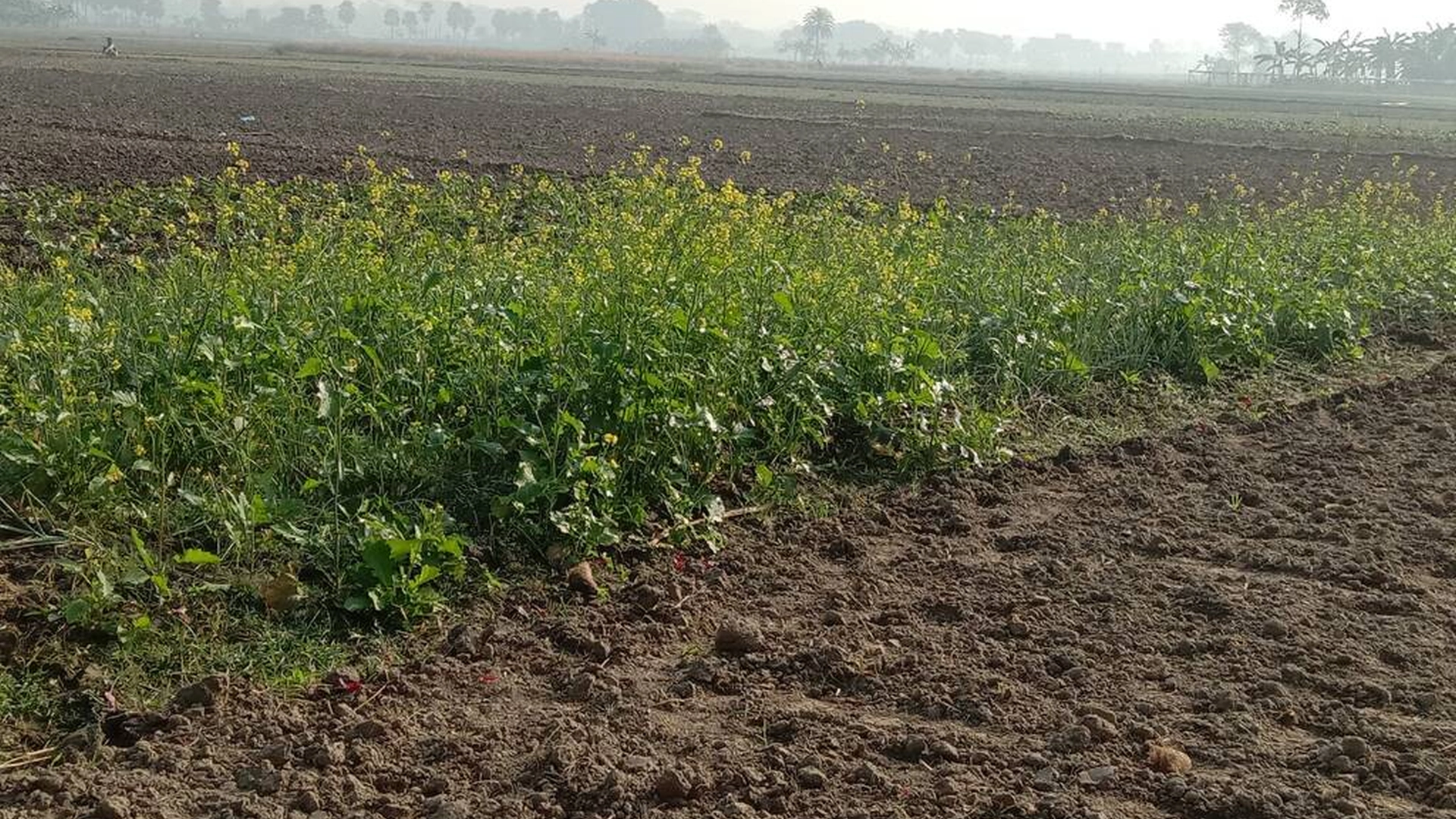
At Terragaon Farms, we learned early that farms do not improve evenly, even when managed the same way. Two plots can sit side by side, receive the same inputs, follow the same schedule, and yet respond very differently over time. One softens faster, holds moisture longer, and begins supporting stronger plant growth, while the other lags behind despite equal effort.
This article documents a real Terragaon trial from our Birbhum lateritic land, where one plot showed visible soil and crop improvement almost a full season earlier than its neighboring plot. The difference was not fertilizer, labor, or timing. The difference was invisible at first glance but obvious once we stopped assuming uniformity.
The Field Setup at Terragaon Farms
Both plots were part of the same contiguous field block. The soil type was red lateritic, low in organic carbon, structurally fragile, and historically overworked. Rainfall exposure, cropping calendar, and management decisions were identical.
Inputs included organic residues, biological preparations, and reduced disturbance practices. There was no preferential treatment given to either plot. Yet by mid-season, one plot showed better aggregation, darker topsoil color, and improved crop vigor.
The question was not why one plot failed. The question was why the other succeeded faster.
The Core Observation in One Sentence
The plot that improved faster had a quieter history, partial shade, and less past stress on its soil biology.
Micro Variation Exists Even on Flat Land
Soil Is Never Uniform
One of the most damaging assumptions in small farming is that land within the same boundary behaves the same way. At Terragaon Farms, we have repeatedly observed that even visually flat land carries micro variation in texture, compaction, drainage, and biological activity.
In this case, the faster-improving plot had slightly better crumb structure below the surface. This was not visible from above but became clear during shallow digging. Roots penetrated more easily, and earthworm presence appeared earlier.
Micro variation often comes from small differences in how water moves, how pressure was applied historically, or how organic matter accumulated unevenly over decades.
Why Micro Variation Matters in Lateritic Soil
Laterite soils are unforgiving. Once structure collapses, recovery takes time. A plot that starts even marginally better can rebuild faster because microbial systems need fewer barriers to re-establish.
The lagging plot was not worse managed. It was simply starting from a more damaged baseline.
Shade Is a Silent Soil Healer
Partial Shade Reduced Daily Stress
The faster-improving plot received partial afternoon shade from a tree line on its western edge. This reduced surface temperature during peak heat hours.
Lower soil temperature meant
• Less microbial die-off
• Slower moisture evaporation
• Reduced surface crusting
In Birbhum summers, even a few degrees of temperature moderation can change biological survival rates dramatically.
Shade Does Not Mean Low Productivity
A common fear among farmers is that shade reduces yield. In reality, strategic shade often improves soil function first, which later supports more stable productivity.
At Terragaon Farms, the shaded plot did not show weaker crops. It showed steadier growth and less stress response.
Field History Leaves Long Shadows
Past Use Shapes Present Response
The slower plot had a history of heavier tillage and repeated mono-cropping. The faster plot had been partially fallow for several years due to access constraints.
That fallow period allowed organic residues to decompose slowly and microbial populations to survive without repeated disruption.
Soil remembers how it was treated. Inputs cannot erase history instantly.
Why Inputs Alone Cannot Equalize Plots
This trial reinforced an uncomfortable truth. Equal inputs do not create equal outcomes when starting conditions differ.
Trying to force uniformity through higher inputs often worsens the weaker plot by increasing stress rather than resilience.
What This Means for Small Farmers
Stop Expecting Uniform Results
Uniform treatment does not guarantee uniform response. Observing plot-wise behavior is more important than following rigid schedules.
Let Better Plots Lead the System
Instead of forcing lagging plots, allow stronger plots to stabilize first. Use them as learning references, not benchmarks for pressure.
Adjust Expectations, Not Just Inputs
Soil improvement is not a race. Faster plots are not better managed. Slower plots are not failures. They are simply telling a longer story.
A Concise Answer
One plot improved faster than another on the same farm because of micro soil variation, partial shade reducing heat stress, and a gentler field history that allowed soil biology to recover sooner, even under identical management.
What We Learned at Terragaon Farms
This trial changed how we read our land. We no longer ask why a plot is slow. We ask what it has survived.
Soil improvement is not about equality. It is about context.
Transferability Notes
These observations are from lateritic soil under Birbhum conditions. In heavier alluvial soils, the influence of shade may be lower, while drainage history may play a bigger role. Farmers should observe their own micro patterns before applying conclusions universally.

Krittika Das is a field practitioner and primary author at Terragaon Farms in Birbhum, West Bengal. Her writing is grounded in daily farm work, long-term soil observation, and small-land realities of eastern India. She focuses on natural farming, soil ecology, ethical dairy, and low-input systems, translating field experience into clear, practical knowledge for farmers and conscious food consumers.